The rapture in the KJV Bible refers to believers being caught up to meet Christ in the air, as described in 1 Thessalonians 4:17. While the word “rapture” never appears in the King James Version, twelve key Scripture passages reveal this profound doctrine of Christ suddenly gathering His church before establishing His earthly kingdom. Where Is The Rapture Mentioned in the KJV Bible? 12 Scriptures.
Millions search for rapture verses yet miss the Greek word harpazo—the secret hiding in plain sight. This term, meaning “to seize” or “snatch away,” transforms how you’ll read familiar passages forever. The Bible’s most explosive promise sits waiting in verses you’ve read dozens of times without recognizing their full significance.
Understanding where the rapture is mentioned in Scripture requires examining both explicit passages like 1 Corinthians 15:51-52 and symbolic references in Revelation 4:1-2. These twelve passages form a comprehensive picture of Christ’s return for His saints, distinguishing the rapture from the Second Coming while offering blessed hope to every believer watching for His appearing.
Understanding Rapture vs. Second Coming: Why the Distinction Matters
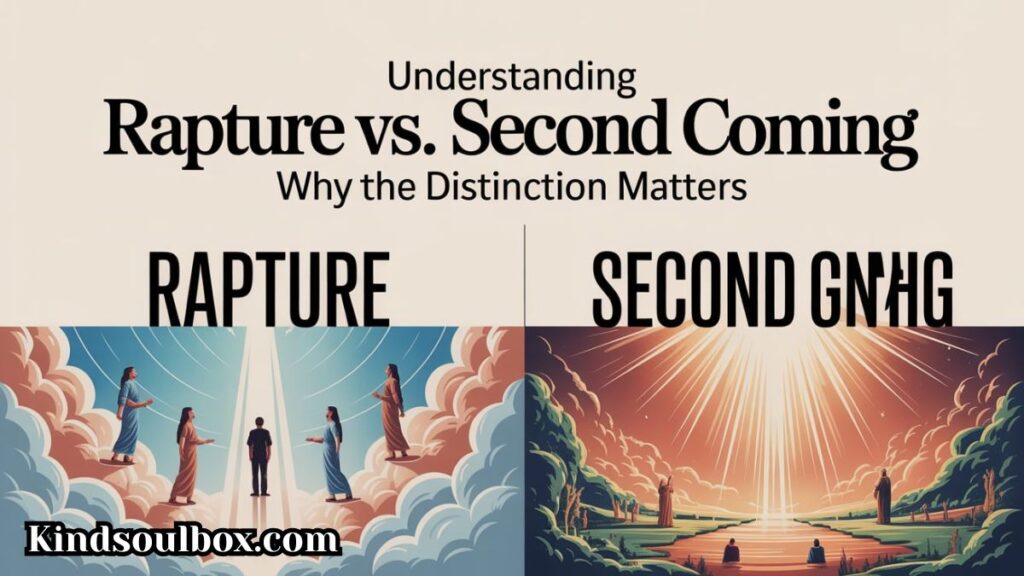
Many Christians confuse the rapture with the Second Coming of Christ. These represent distinct events in end-times prophecy according to dispensational theology.
The rapture describes Jesus coming for His church. Believers—both dead in Christ and living believers—meet the Lord in the air. This happens suddenly, invisibly to the world. No one sees Christ descend to earth. Instead, the church vanishes in an instant.
The Second Coming involves Jesus returning with His saints. Every eye sees Him. He physically touches down on the Mount of Olives. This visible, glorious appearing establishes His millennial reign on earth.
Key Differences Between Rapture and Second Coming
| Characteristic | The Rapture | The Second Coming |
|---|---|---|
| Visibility | Invisible to unbelievers | Every eye shall see Him |
| Location | Meets church in clouds | Descends to Mount Olivet |
| Purpose | Judge nations, establish a kingdom | Judge nations, establish kingdom |
| Participants | Church only | Saints return with Christ |
| Timing | Before tribulation (pre-trib view) | After tribulation |
| Earth Impact | None initially | Dramatic geological changes |
| Duration | Instantaneous | Progressive revelation |
The pre-tribulation rapture position argues that believers won’t endure the Great Tribulation. God removes His church before pouring out divine judgment on an unbelieving world. This view gained popularity through John Nelson Darby’s teachings in the 1800s and the Scofield Reference Bible.
Critics argue for post-tribulation timing. They see one unified return. The debate continues, but understanding the distinction helps interpret rapture KJV passages correctly.
The Greek Foundation: “Harpazo” and Why “Rapture” Doesn’t Appear in KJV
Here’s the linguistic key: “harpazo” is the original Greek word translated in English Bibles. The Latin Vulgate rendered harpazo as “rapturo”—the root of our English word “rapture.”
The KJV translators chose “caught up” instead of creating an English cognate from Latin. So technically, the rapture in Scripture exists conceptually but not terminologically in the King James Version.
What Does Harpazo Actually Mean?
The Greek term harpazo appears 14 times in the New Testament. It means:
- To seize suddenly
- To snatch away forcefully
- To catch up with violence
- To claim for oneself eagerly
- To rescue from danger
Think of someone grabbing a child from oncoming traffic. That urgency, that forceful rescue—that’s harpazo.
Harpazo appears in these contexts:
- Matthew 11:12 – The violent take the kingdom by force
- Matthew 13:19 – Satan snatches away the word
- John 6:15 – They would take Jesus by force to make Him king
- John 10:12 – The Wolf catches and scatters the sheep
- John 10:28-29 – No one can pluck believers from Father’s hand
- Acts 8:39 – The Spirit of the Lord caught away Philip
- Acts 23:10 – Soldiers rescued Paul from the crowd
- 2 Corinthians 12:2-4 – Paul caught up to the third heaven
- 1 Thessalonians 4:17 – We shall be caught up together
- Jude 1:23 – Pulling them out of the fire
- Revelation 12:5 – Child caught up unto God
Notice Philip’s experience in Acts 8:39. After baptizing the Ethiopian eunuch, the Spirit harpazo’d Philip to another location. One moment, he’s standing in water, the next he’s miles away in Azotus. That’s the forceful, sudden nature of this word.
When Paul describes believers taken to heaven in 1 Thessalonians 4:17, he uses this exact term. The rapture doctrine builds primarily on this word choice.
Primary Rapture Passage: 1 Thessalonians 4:13-18

“But I would not have you to be ignorant, brethren, concerning them which are asleep, that ye sorrow not, even as others which have no hope. For if we believe that Jesus died and rose again, even so they also who sleep in Jesus will God bring with him.
For this we say unto you by the word of the Lord, that we who are alive and remain unto the coming of the Lord shall not prevent them which are asleep. for the Lord himself shall descend from heaven with a shout, with the voice of the archangel, and with the trump of God: and the dead in Christ shall rise first:
Then we who are alive and remain, shall be caught up together with them in the clouds, to meet the Lord in the air: and so shall we ever be with the Lord. Wherefore comfort one another with these words.”
Breaking Down the Sequence
Paul outlines a precise chronology with six distinct steps.
Step 1: The Lord Himself Descends
Jesus personally comes from heaven. Not an angel. Not a representative. The Lord Himself initiates this event.
Step 2: Three Audible Signals
Three supernatural sounds accompany His descent. First, a commanding shout (Greek: keleusma—a military command). Second, the voice of the archangel (likely Michael, defender of Israel). Third, the trumpet of God (the last trumpet mentioned in 1 Corinthians 15:52).
Step 3: Resurrection of Dead Believers
The dead in Christ shall rise first. Bodies emerge from graves, oceans, and cremation ashes. Resurrection of the dead precedes transformation of the living. This answers the Thessalonians’ concern about deceased believers.
Step 4: Living Believers Transformed
Those alive when this occurs experience instantaneous change. Mortal becomes immortal without tasting death. This generation won’t sleep but will be changed in a moment.
Step 5: Meeting in the Clouds
Both groups—resurrected and transformed—are caught up together in the clouds. This is the harpazo moment. We meet the Lord in the air. Notice the corporate nature: “together” emphasizes unity.
Step 6: Eternal Union
“So shall we ever be with the Lord.” Permanent, unbreakable fellowship begins. Separation ends forever. Death loses its sting completely.
The Mystery Revealed: 1 Corinthians 15:51-52
Paul calls the rapture a “mystery” in this resurrection chapter. In biblical terminology, a mystery isn’t something mysterious—it’s a truth previously hidden but now revealed.
The Complete Passage (KJV)
“Behold, I shew you a mystery; We shall not all sleep, but we shall all be changed, In a moment, in the twinkling of an eye, at the last trump: for the trumpet shall sound, and the dead shall be raised incorruptible, and we shall be changed.”
“We Shall Not All Sleep”
Some believers won’t die. They’ll be alive when Christ returns. This generation won’t taste death but will experience instantaneous transformation.
The early church believed Christ would return in their lifetimes. Paul includes himself: “We shall not all sleep.” While that generation passed, the promise remains. One generation will see this fulfilled.
“In a Moment, in the Twinkling of an Eye”
The Greek word for “moment” is atomos—where we get “atom.” Indivisible. The smallest measurable unit of time.
“Twinkling of an eye” doesn’t mean a slow blink. It refers to the time light takes to reflect off your eye. Faster than you can process. Instantaneous.
This contradicts theories about gradual transformation or progressive rapture. Paul emphasizes shocking speed. One microsecond you’re mortal, the next immortal.
The Last Trump
“At the last trump” generates significant discussion. What is this final trumpet?
Jewish Context: Israel’s feast days featured trumpet calls. The Feast of Trumpets (Rosh Hashanah) included 100 trumpet blasts. The final, longest blast—called the “tekiah gedolah”—was the last trump. Some scholars connect the rapture to this feast.
Military Context: Roman armies used trumpet calls for assembly. The last trumpet signaled the final gathering before the march.
Prophetic Context: Multiple trumpets sound throughout Revelation’s judgments. This could be the final trumpet before tribulation judgments begin.
The trumpet announces the resurrection of the dead and the transformation of the living. It’s God’s grand assembly call for His people.
Resurrection Bodies
Paul explains these new bodies are:
- Incorruptible – No decay, disease, or death
- Powerful – Not limited by current physical constraints
- Glorious – Reflecting Christ’s resurrection body
- Spiritual – Animated by the Spirit, not blood
Jesus’ resurrection body serves as the prototype. He walked through walls yet ate fish. He appeared and disappeared, yet had flesh and bones. This combination of physical solidity and spiritual transcendence defines our future state.
Christ’s Own Words: John 14:1-3
Jesus personally promised to return for His followers. This Upper Room discourse happened hours before His crucifixion.
The Promise (KJV)
“Let not your heart be troubled: ye believe in God, believe also in me. In my Father’s house are many mansions: if it were not so, I would have told you. I go to prepare a place for you. And if I go and prepare a place for you, I will come again, and receive you unto myself; that where I am, there ye may be also.”
“I Will Come Again”
Jesus makes this personal. Not “someone will come” but “I will come again.” He promises His own return.
“Receive you unto myself” carries an intimate meaning. The Greek word paralambano means to take someone alongside, to take to oneself. A bridegroom took his bride to himself after preparing their home.
The Wedding Analogy
Jewish wedding customs illuminate this passage:
- Betrothal – Families arranged marriage; the couple is legally bound
- Preparation Period – Groom returned to his father’s house to build their dwelling
- Unknown Timing – Only the father knew when construction was sufficient
- Sudden Arrival – The Groom came unexpectedly for his bride
- Wedding Celebration – Week-long feast at the father’s house
Jesus positions Himself as the bridegroom. The church is His betrothed bride. He’s preparing our dwelling in the Father’s house. When the Father says everything’s ready, Jesus will come for us suddenly, unexpectedly.
This mirrors the rapture doctrine perfectly. Sudden. Personal. To bring us where He is.
“Where I Am”
Jesus doesn’t say “where I will be” but “where I am.” Present tense. He exists in the eternal now. When we meet Him in the air, we enter His timeless presence. Past, present, and future collapse into eternal communion with Christ.
The Ascension Pattern: Acts 1:9-11
The ascension of Christ establishes the pattern for His return. Forty days after the resurrection, Jesus led His disciples to the Mount of Olives.
The Account (KJV)
“And when he had spoken these things, while they beheld, he was taken up; and a cloud received him out of their sight. And while they looked steadfastly toward heaven as he went up, behold, two men stood by them in white apparel, who also said, Ye men of Galilee, why stand ye gazing up into heaven? this same Jesus, which is taken up from you into heaven, shall so come in like manner as ye have seen him go into heaven.”
“In Like Manner”
The angels promise Christ will return “in like manner” as He left. How did He leave?
- Visibly – Disciples watched Him ascend
- Bodily – Physical resurrection body, not spirit form
- From Mount of Olives – Specific geographical location
- With clouds – Cloud received Him from their sight
- Vertical ascent – He went up into heaven
The Second Coming matches this pattern perfectly. Zechariah 14:4 predicts His feet touching the Mount of Olives, causing it to split. That’s literal, physical return.
But does the rapture match this pattern? Here’s where interpretation diverges:
Pre-trib position: Acts 1:9-11 describes the Second Coming, not the rapture. The rapture happens differently—Christians meet Him in the air, never touching earth.
Post-trib position: This passage describes one unified return. The rapture and Second Coming happen simultaneously.
Cloud Significance
Clouds carry massive symbolic weight in Scripture:
- Exodus 13:21 – Pillar of cloud guided Israel
- Exodus 19:9 – God spoke to Moses in a thick cloud
- Matthew 17:5 – Cloud overshadowed Jesus at the transfiguration
- Daniel 7:13 – Son of Man came with clouds of heaven
- Revelation 1:7 – He cometh with clouds
Clouds represent divine presence and glory. When Jesus ascended, God’s glory enveloped Him. When He returns, that same glory will be visible to all.
Matthew 24:36-44: The Unknown Hour
Jesus Himself taught about His return’s timing—or rather, its unpredictability. This Olivet Discourse passage addresses the end times.
Key Verses (KJV)
“But of that day and hour knoweth no man, no, not the angels of heaven, but my Father only. But as the days of Noe were, so shall also the coming of the Son of Man be. For as in the days that were before the flood, they were eating and drinking, marrying and giving in marriage, until the day that Noe entered into the ark, and knew not until the flood came, and took them all away; so shall also the coming of the Son of Man be. Then shall two be in the field; the one shall be taken, and the other left. One shall be grinding at the mill; the one shall be taken, and the other left. Watch therefore: for ye know not what hour your Lord doth come.”
The Noah Comparison
Jesus compares His coming to Noah’s flood. People lived normally—eating, drinking, marrying. Life seemed permanent. They ignored Noah’s warnings.
Then judgment struck suddenly. The flood “took them all away.”
Notice the dual meaning of “took away”:
- The flood took unbelievers in judgment
- The ark took Noah’s family to safety
This parallels the rapture. One group experiences sudden removal to safety. Another faces unexpected judgment.
“One Taken, One Left”
This controversial phrase appears twice:
- Two in the field – One taken, one left
- Two grinding at the mill – One taken, one left
Rapture interpretation: The taken are believers caught up to meet Christ. The left behind face tribulation.
Judgment interpretation: The taken are removed in judgment, like flood victims. The left behind are righteous who remain for Christ’s kingdom.
Context matters enormously. The flood took unbelievers in judgment. But the overall passage emphasizes watching and readiness, suggesting taking something positive.
The parallel passage in Luke 17:34-37 adds disturbing detail. When disciples ask, “Where, Lord?” Jesus answers: “Wheresoever the body is, thither will the eagles be gathered together.” This sounds like judgment and death—bodies and vultures.
Interpreters debate whether Matthew 24 and Luke 17 describe the rapture or the Second Coming. The uncertainty keeps students humble.
Watchfulness Required
Jesus commands: “Watch therefore.” Why watch if you can calculate the timing? Because you can’t.
Every generation of believers should live ready for Christ’s return. Date-setters embarrass Christianity repeatedly. Harold Camping’s 2011 prediction. The Y2K panic. Countless others throughout church history.
“No man knoweth the day or hour” means exactly that. Anyone claiming to know contradicts Christ directly.
Revelation 4:1-2: “Come Up Hither.”
The Apostle John’s heavenly vision in Revelation provides symbolic support for rapture theology. After addressing the seven churches (Revelation 2-3), John receives an invitation.
The Text (KJV)
“After this I looked, and, behold, a door was opened in heaven: and the first voice which I heard was as it were of a trumpet talking with me; which said, Come up hither, and I will shew thee things which must be hereafter. And immediately I was in the spirit: and, behold, a throne was set in heaven, and one sat on the throne.”
Typological Interpretation
Pre-tribulation advocates see John as representing the church:
- Chapters 1-3 cover the church age
- Chapter 4 begins with “Come up hither”—symbolic rapture
- Church isn’t mentioned again until Christ returns in chapter 19
- Chapters 6-18 detail tribulation judgments
John being “in the spirit” immediately after this call parallels believers’ transformation and translation to heaven.
The Trumpet Voice
“The first voice which I heard was as it were of a trumpet” connects to 1 Thessalonians 4:16 and 1 Corinthians 15:52. The trumpet of God summons believers heavenward.
This voice was Jesus Himself—the same voice John heard in Revelation 1:10-11. Christ personally calls His church upward.
Criticism of This Interpretation
Critics argue this represents John’s prophetic experience only, not the church’s rapture. The symbolism is suggestive but not conclusive.
However, the church’s absence from tribulation chapters remains striking. After a detailed discussion of seven churches in Asia, the church vanishes from Revelation’s narrative until the marriage supper.
Where is the church during the Great Tribulation? Pre-trib theology answers: in heaven, having been raptured before judgment begins.
Additional Supporting Passages
2 Thessalonians 2:1-12: The Restrainer
Paul addresses confusion about the Day of the Lord in his second letter to the Thessalonians. False teachers claimed the tribulation had already begun.
Key Verse (KJV):
“For the mystery of iniquity doth already work: only he who now letteth will let, until he be taken out of the way. And then shall that Wicked be revealed, whom the Lord shall consume with the spirit of his mouth, and shall destroy with the brightness of his coming.”
“He who now letteth” uses archaic English. “Let” meant “restrain” in 1611. A restraining force currently prevents the Antichrist’s full revelation.
Who is this restrainer?
The Holy Spirit: Dwelling in the church, the Spirit restrains evil. When the church is raptured, the Spirit’s restraining ministry ends. Then the man of sin appears.
Human Government: Romans 13 presents government as God’s restrainer of evil. When governments collapse during tribulation, Antichrist rises.
Michael the Archangel: Daniel 12:1 mentions Michael standing up for Israel. His activity change could trigger tribulation.
Most pre-tribulation scholars identify the restrainer as the Holy Spirit in the church. When the church is caught up, restraint lifts, and hell breaks loose on earth.
Luke 17:34-36: Night and Day Simultaneously
Luke’s parallel account to Matthew 24 adds geographical detail proving global simultaneity.
The Text (KJV):
“I tell you, in that night there shall be two men in one bed; the one shall be taken, and the other shall be left. Two women shall be grinding together; the one shall be taken, and the other left. Two men shall be in the field; the one shall be taken, and the other shall be left.”
Notice the time indicators:
- Night – Two in bed
- Day – Women grinding grain (morning chore)
- Day – Men working in the field
This describes different time zones experiencing the same event simultaneously. When it’s night in one location, it’s day elsewhere. The rapture happens globally at the same instant, regardless of local time.
This detail strengthens literal interpretation. Jesus describes an actual, physical event occurring worldwide at once.
Revelation 19:11-15: Coming With His Saints
This passage describes the Second Coming, not the rapture, but it’s crucial for understanding the timeline.
The Text (KJV):
“And I saw heaven opened, and behold a white horse; and he that sat upon him was called Faithful and True, and in righteousness he doth judge and make war. His eyes were as a flame of fire, and on his head were many crowns; and he had a name written, that no man knew, but he himself. And he was clothed with a vesture dipped in blood: and his name is called The Word of God. And the armies which were in heaven followed him upon white horses, clothed in fine linen, white and clean. and out of his mouth goeth a sharp sword, that with it he should smite the nations: and he shall rule them with a rod of iron: and he treadeth the winepress of the fierceness and wrath of Almighty God.”
The Armies Following Him
“The armies which were in heaven followed him.” Who comprises these armies?
Revelation 19:8 identifies them as wearing “fine linen, white and clean,” which represents the “righteousness of saints.” These are redeemed humans, not angels.
Question: How did saints get to heaven to return with Christ?
Pre-trib answer: They were raptured before the tribulation, spent seven years at the marriage supper, and now return for judgment and kingdom establishment.
If the rapture happens after the tribulation, believers immediately return with Christ. No time for heavenly celebration. The pre-tribulation rapture allows for this heavenly interlude.
Passages Describing Christ’s Kingdom (Not Rapture Events)

Several passages in rapture discussions actually describe Christ’s millennial reign or eternal kingdom rather than the catching away itself.
Daniel 2:44: The Stone Kingdom
“And in the days of these kings shall the God of heaven set up a kingdom, which shall never be destroyed: and the kingdom shall not be left to other people, but it shall break in pieces and consume all these kingdoms, and it shall stand for ever.”
Daniel’s interpretation of Nebuchadnezzar’s dream reveals a stone cut without hands that destroys earthly kingdoms and grows into a mountain filling the earth. This represents Christ’s eternal kingdom.
This happens at the Second Coming, not the rapture. Christ establishes visible, political rule over the earth. The millennium—Christ’s thousand-year reign—fulfills this prophecy.
Zechariah 14:4: Physical Return to Mount Olivet
“And his feet shall stand in that day upon the mount of Olives, which is before Jerusalem on the east, and the mount of Olives shall cleave in the midst thereof toward the east and toward the west, and there shall be a very great valley; and half of the mountain shall remove toward the north, and half of it toward the south.”
This describes a dramatic geological transformation when Christ’s feet touch the Mount of Olives. The mountain splits, creating a valley.
This is the Second Coming, not the rapture. In the rapture, Christ doesn’t touch earth. Believers meet Him in the air. Here, He physically stands on the mountain, causing catastrophic changes.
Revelation 21:1: New Heaven and New Earth
“And I saw a new heaven and a new earth: for the first heaven and the first earth were passed away; and there was no more sea.”
The new heaven and new earth follow the millennium, the final judgment, and the destruction of the old order. This is the eternal state—the ultimate fulfillment of God’s redemptive plan.
The rapture is an event. The new creation is the eternal destination. Don’t confuse the journey with the arrival.
Luke 1:33: Christ’s Everlasting Kingdom
“And he shall reign over the house of Jacob for ever; and of his kingdom there shall be no end.”
The angel Gabriel promises Mary that her son will rule eternally. This speaks to Christ’s everlasting dominion, not the rapture mechanism.
The rapture removes the church before judgment. The eternal kingdom is what comes after all judgments, after the millennium, after Satan’s final rebellion. Everlasting life in Christ’s kingdom is the ultimate promise.
Theological Implications Across Denominations

Different Christian traditions interpret these rapture Scriptures through varied theological lenses.
Who Believes in Pre-Tribulation Rapture?
Dispensationalists predominantly hold this view:
- Most Baptist denominations
- Many Pentecostal and Charismatic churches
- Independent Bible churches
- Dallas Theological Seminary tradition
- Moody Bible Institute tradition
These groups see distinct purposes for Israel and the church. The tribulation targets Israel specifically, completing Daniel’s seventy-week prophecy. The church—a parenthetical mystery—escapes this Jewish-focused judgment.
Alternative Positions
Historic Premillennialists (post-tribulation rapture):
- Many Reformed Baptists
- Some Presbyterian groups
- George Eldon Ladd and other scholars
They see one unified return. Believers endure tribulation but are protected from God’s wrath through it. The rapture and Second Coming occur simultaneously at Christ’s visible return.
Amillennialists (symbolic interpretation):
- Roman Catholic Church
- Eastern Orthodox Churches
- Many Lutheran and Reformed denominations
- Augustine’s tradition
They interpret these passages symbolically or spiritually. The millennium represents the church age. The rapture describes death and resurrection generally, not a specific end-times event.
Preterists (already fulfilled):
- Some Reformed groups
- Reconstructionist theology
They believe these prophecies were fulfilled in 70 AD when Rome destroyed Jerusalem. The “coming” was judgment through Roman armies, not a future physical return.
Why the Difference Matters
These aren’t minor disagreements. Your eschatological position affects:
- Mission urgency – Is time running out, or are we building Christ’s kingdom progressively?
- Israel theology – Does Israel have ongoing prophetic significance?
- Suffering expectation – Should Christians expect tribulation or escape?
- Political engagement – Reform society or wait for Christ’s kingdom?
Unity in essentials doesn’t require agreement on eschatology. Christians across these positions share salvation by grace through faith in Christ alone.
Historical Development: When Did Rapture Theology Emerge?
The rapture doctrine, as popularly understood today, didn’t exist in early church teaching. Its development reveals important context.
Early Church Fathers
Justin Martyr (100-165 AD), Irenaeus (130-202 AD), and Tertullian (155-240 AD) taught premillennialism—Christ would return to establish an earthly kingdom. They expected tribulation to precede this.
None distinguished between a secret rapture and a visible second coming. They anticipated one return of Christ after which believers would reign with Him during the millennium.
John Nelson Darby (1800-1882)
The modern pre-tribulation rapture teaching emerged through John Nelson Darby, an Anglo-Irish Bible teacher and founder of the Plymouth Brethren movement.
Darby developed dispensationalism—dividing biblical history into distinct periods (dispensations) where God relates differently to humanity. He saw the church age as a parenthetical period, distinct from God’s plan for Israel.
This framework necessitated removing the church before God resumed His program with Israel during the tribulation. Thus, the pre-trib rapture became essential to dispensational theology.
Cyrus Scofield and Popular Adoption
C.I. Scofield’s Reference Bible (1909) spread dispensationalism throughout American evangelicalism. His extensive notes taught pre-tribulation rapture as a biblical fact.
For millions of Christians, the Scofield Bible was the Bible. Its interpretive notes carried almost scriptural authority. The rapture doctrine became orthodoxy in fundamentalist and evangelical churches.
Modern Pop Culture Impact
The “Left Behind” series by Tim LaHaye and Jerry Jenkins (1995-2007) embedded pre-trib rapture theology in popular consciousness. Over 65 million copies sold worldwide.
Movies, songs, and countless sermons reinforced this view. Many Christians can’t separate rapture theology from biblical teaching itself—they assume Scripture explicitly teaches what’s actually a recent interpretive framework.
Why History Matters
Understanding this development doesn’t invalidate pre-tribulation rapture theology. Truth isn’t determined by age. But it should humble students of biblical prophecy.
For 1,800 years, the church functioned without this teaching. Early believers faced horrific persecution without expecting escape. They died singing hymns, not looking for a rapture.
Maybe God revealed this truth progressively. Maybe we’ve misinterpreted. Either way, eschatological humility serves us well.
Practical Application: Living with Blessed Hope
Whether you’re pre-trib, post-trib, or amillennial, these Scriptures offer practical guidance for Christian living.
Comfort in Grief
1 Thessalonians 4:18 commands: “Wherefore comfort one another with these words.” Paul’s teaching about resurrection and rapture specifically addresses believers’ grief over deceased loved ones. Where Is The Rapture Mentioned in the KJV Bible?
Death doesn’t separate Christians permanently. The dead in Christ rise first. Believing that children, spouses, parents, and friends will be reunited. Physical death is a temporary sleep before resurrection morning. Where Is The Rapture Mentioned in the KJV Bible?
This comfort doesn’t minimize grief. Jesus wept at Lazarus’ tomb despite knowing He’d raise him. But Christian grief includes hope—blessed hope that transforms mourning. Where Is The Rapture Mentioned in the KJV Bible?
Motivation for Holiness
1 John 3:2-3 connects Christ’s return to personal purity: “We know that, when he shall appear, we shall be like him; for we shall see him as he is. And every man that hath this hope in him purifieth himself, even as he is pure.”
The rapture hope motivates holy living. If Christ could return any moment, worldly entanglements lose appeal. Eternal perspective transforms daily choices. Where Is The Rapture Mentioned in the KJV Bible?
Titus 2:12-13 similarly links the “blessed hope” to godly living: “Teaching us that, denying ungodliness and worldly lusts, we should live soberly, righteously, and godly, in this present world; Looking for that blessed hope, and the glorious appearing of the great God and our Saviour Jesus Christ.”
Evangelistic Urgency
If Christ’s return is imminent, procrastinating evangelism is deadly. 2 Corinthians 6:2 declares: “Behold, now is the accepted time; behold, now is the day of salvation.”
The rapture could happen before you finish this sentence. That reality should drive passionate gospel proclamation. People need Christ now. Where Is The Rapture Mentioned in the KJV Bible?
However, date-setting undermines credibility. Failed predictions turned multitudes away from Christianity. Harold Camping’s followers abandoned faith after his rapture predictions failed.
Urgency without dates maintains both passion and integrity.
Unity Despite Differences
Christians genuinely disagree about eschatology. Denominations are split over these issues. Friendships fractured. Families divided. Where Is The Rapture Mentioned in the KJV Bible?
Yet the Apostle Paul commanded: “Endeavouring to keep the unity of the Spirit in the bond of peace” (Ephesians 4:3).
Essential doctrines require agreement:
- Christ’s deity and humanity
- Salvation by grace through faith
- Christ’s physical resurrection
- His literal return
Rapture timing isn’t an essential doctrine. Pre-trib, post-trib, and amillennial believers share these core truths. We can debate eschatology without questioning each other’s salvation or faithfulness. Where Is The Rapture Mentioned in the KJV Bible?
Watching and Readiness
Jesus repeatedly commanded watchfulness. Matthew 24:42: “Watch therefore: for ye know not what hour your Lord doth come.”
Luke 12:40: “Be ye therefore ready also: for the Son of man cometh at an hour when ye think not.”
Watching doesn’t mean staring at the sky. It means living with conscious awareness that Christ could return at any moment. Every decision, conversation, and thought happens in light of eternity.
Are you ready? If the trumpet sounded now, would you rise to meet Christ with joy or shame? That’s not about earning salvation—it’s about faithful stewardship of the life He’s given.
Conclusion
Where is the rapture mentioned in the KJV Bible? 12 Scriptures reveal this truth clearly. The word “rapture” doesn’t appear, but the concept does. 1 Thessalonians 4:17 describes believers being caught up. 1 Corinthians 15:52 explains instant transformation. Where Is The Rapture Mentioned in the KJV Bible? Where Is The Rapture Mentioned in the KJV Bible? These passages offer genuine hope. Christ promised to return for His church.
Where is the rapture mentioned in the KJV Bible? 12 Scriptures provide the answer through careful study. John 14:3 records Jesus’ personal promise. Acts 1:9-11 shows His ascension pattern. Where Is The Rapture Mentioned in the KJV Bible? Whether pre-tribulation or post-tribulation, one truth remains certain: Christ is coming again. Be ready. Watch faithfully. Live expectantly. The trumpet will sound soon. Where Is The Rapture Mentioned in the KJV Bible?
FAQs
Does the word “rapture” actually appear in the KJV Bible?
No, the word “rapture” doesn’t appear in the KJV. The Greek word “harpazo” is translated as “caught up” in 1 Thessalonians 4:17, which forms the basis of the rapture doctrine.
What is the clearest rapture verse in the KJV Bible?
1 Thessalonians 4:16-17 provides the most explicit description: believers will be “caught up together in the clouds to meet the Lord in the air” when Christ descends with a shout and trumpet call.
Is the rapture the same as the Second Coming of Christ?
No, they’re distinct events in pre-tribulation theology. The Rapture removes the church before the tribulation, while the Second Coming occurs when Christ returns to earth to establish His kingdom after the tribulation.
When will the rapture happen according to the Bible?
Matthew 24:36 clearly states “no man knoweth the day or hour” of Christ’s return. Any specific date predictions contradict Scripture and should be rejected as false teaching.
Do all Christian denominations believe in the rapture?
No, the pre-tribulation rapture is primarily held by dispensationalist evangelicals and Baptists. Catholic, Orthodox, Reformed, and many mainline Protestant churches interpret these passages differently or symbolically.