The number 11 in the Bible represents disorder, incompleteness, and transition—consistently appearing when divine order collapses into chaos. This powerful numerical pattern marks moments of judgment, rebellion, and the uncomfortable space between God’s perfect structure and human failure throughout Scripture.
Ancient Hebrew scholars recognized something unsettling about eleven. It exceeds God’s law (10) yet falls tragically short of His governmental perfection (12). From the corrupted earth of Genesis to the betrayal of Judas, leaving eleven apostles, this number whispers warnings you can’t ignore.
Biblical numerology isn’t mysticism—it’s divine fingerprints woven through God’s Word. When you track where eleven surfaces in Scripture, patterns emerge that illuminate both ancient narratives and your personal spiritual journey. Understanding this number unlocks a deeper comprehension of judgment, grace, and restoration throughout biblical history, revealing how God transforms chaos back into order.
The Foundation: Biblical Numerology and Divine Patterns
Why Numbers Matter in Scripture
Biblical numerology explained isn’t about fortune-telling or secret codes. It’s about recognizing how God embedded meaning into creation itself. Numbers carry weight throughout Scripture, and ancient Hebrew culture understood this intuitively.
Consider these established patterns:
- Number 7: Divine completion and perfection (God rested on the seventh day)
- Number 10: God’s law and order (Ten Commandments)
- Number 12: Governmental perfection and divine authority (12 crews, 12 apostles)
- Number 40: Testing, trial, and probation (40 days/years appears repeatedly)
Number 11 falls uncomfortably between ten and twelve. It exceeds God’s law (10) but falls short of His government (12). This positioning isn’t coincidental—it’s revelatory.
Three Core Meanings of Eleven
When you study Scripture carefully, eleven consistently represents three interconnected themes:
1. Disorder and Chaos – The disruption of God’s established order. Eleven appears when structure collapses, when rebellion fractures unity, when sin introduces confusion into previously ordered systems.
2. Judgment and Consequence – God’s response to human rebellion. Because eleven represents disorder, it often precedes or accompanies divine judgment. It’s the number that says, “You’ve departed from my ways, and consequences follow.”
3. Transition and Incompleteness – The uncomfortable space between what was and what will be. Eleven marks seasons of waiting, adjustment, and preparation before restoration.
The apostle Paul would later write, “For God is not the author of confusion, but of peace” (1 Corinthians 14:33). Eleven represents the opposite—not God’s authorship, but humanity’s rejection of His peace.
Genesis: When Order Collapsed Into Chaos
The Corrupted Earth (Genesis 6:11)
Genesis 6:11 delivers one of Scripture’s most sobering statements: “The earth also was corrupt before God, and the earth was filled with violence.“
Notice the chapter and verse—6:11. The number 11 appears at the exact moment Scripture describes earth’s complete moral collapse. This wasn’t random. From Adam to Noah spans ten generations—a full cycle representing divine order. But by the time we reach this verse, corruption had thoroughly infiltrated humanity.
The Hebrew word translated “corrupt” (shachath) means ruined, destroyed, spoiled beyond recognition. What God created good had become unrecognizable. Violence (chamas) filled every corner—not just physical brutality, but injustice, cruelty, and oppression.
God’s sovereignty remained intact, but humanity had exercised its free will toward destruction. The flood that followed wasn’t arbitrary anger. It was divine intervention—judgment responding to complete disorder.
| Biblical Pattern | Scripture Reference | Significance |
|---|---|---|
| 10 Generations | Adam to Noah | Complete cycle of divine order |
| Corruption Noted | Genesis 6:11 | Disorder enters at verse 11 |
| Divine Response | Genesis 6-8 | Judgment through flood |
| New Beginning | Genesis 9 | Order restored through covenant |
The Tower of Babel (Genesis 11)
Perhaps the most obvious example of eleven’s significance appears in Genesis 11—the entire chapter is dedicated to humanity’s unified rebellion against God.
After the flood, people should’ve spread throughout the earth as God commanded. Instead, they converged on the plain of Shinar with audacious plans: “Come, let us build ourselves a city, and a tower whose top is in the heavens; let us make a name for ourselves” (Genesis 11:4).
This wasn’t architecture—it was idolatry. They wanted to build a monument to human achievement, to reach heaven through their own efforts, to establish unity apart from God. The irony cuts deep: they sought unity while rejecting the only true source of peace.
God’s judgment came swiftly. He confused their language, scattering them across the earth. The Tower of Babel became history’s ultimate symbol of chaos, replacing order, confusion replacing clarity.
The spiritual significance here resonates today. Whenever humanity attempts unity while excluding God, confusion inevitably follows. Political movements, social revolutions, even religious systems that marginalize Christ—they all contain seeds of Babel.
Joseph’s Troubling Dream (Genesis 37:9)
Joseph experienced a prophetic dream that disturbed his already fractured family: “Look, I have dreamed another dream. And this time, the sun, the moon, and the eleven stars bowed down to me” (Genesis 37:9).
Eleven stars. Eleven brothers. Notice what’s missing—Joseph himself. The family wasn’t complete without him, yet his dream predicted his brothers’ betrayal and his eventual elevation.
This moment captures eleven’s transitional nature perfectly. Jacob’s household stood incomplete, teetering between divine promise and family dysfunction. Esau had already departed. Now, internal strife would scatter Jacob’s sons before they could become the twelve guilds of Israel.
The brothers’ jealousy led to Joseph’s sale into slavery—the ultimate family betrayal. Yet God used this disorder to position Joseph in Egypt, where he’d eventually save his family during famine. Eleven represented the painful transition before restoration to twelve.
Exodus and Wilderness: Physical Manifestations of Spiritual Disorder
The Eleven-Day Journey That Became Forty Years (Deuteronomy 1:2)
“It is an days journey from Horeb by way of Mount Seir to Kadesh Barnea” (Deuteronomy 1:2).
Eleven days. That’s how long it should’ve taken the Israelites to reach the Promised Land from Mount Horeb (Sinai). God had delivered them from Pharaoh, given them His law, and pointed them toward Canaan.
But disobedience transformed eleven days into forty years.
When twelve spies explored Canaan, ten returned with fearful reports. Only Moses, Joshua, and Caleb maintained faith. The people’s rebellion at the border triggered God’s judgment: “except for Caleb… and Joshua… they shall by no means see the land” (Numbers 14:30).
The children of Israel wandered the wilderness for forty years—one year for each day the spies explored. An entire generation died before their descendants entered rest.
This eleven-day journey represents more than geography. It symbolizes how close we can come to God’s promises before unbelief derails us. The spiritual lessons penetrate deeply: faith versus unbelief, obedience versus disobedience, trust in God’s promises versus fear of circumstances.
The Eleven Curtains of the Tabernacle (Exodus 26:7-8)
God’s instructions for the Tabernacle included specific details about its coverings: “You shall also make curtains of goats’ hair, to be a tent over the tabernacle. You shall make eleven curtains” (Exodus 26:7).
Why eleven curtains? Why not ten or twelve?
These curtains formed the outer covering—the visible layer separating the holy sanctuary from the outside world. Made from goats’ hair, they symbolized sin and separation. In contrast, the inner curtains numbered ten, representing divine order and perfection hidden beneath.
The eleven curtains created an imperfect covering over perfection. They represented humanity’s incomplete attempts to approach God’s holiness. This foreshadowed Christ, who would become the perfect covering for sin, the ultimate mediator between God and humanity.
Numbers Chapter 11: Complaining and Consequences
Numbers chapter 11 chronicles one of Israel’s most shameful moments. Despite daily manna from heaven, the people complained: “Who will give us meat to eat? We remember the fish which we ate freely in Egypt” (Numbers 11:4-5).
They despised God’s miraculous provision, craving the flavors of slavery over freedom’s manna. This wasn’t hunger—it was ingratitude bordering on idolatry.
Moses felt overwhelmed by their complaints. God responded by appointing seventy elders to share leadership responsibilities, then sending quail in abundance. But judgment accompanied the meat: “While the meat was still between their teeth… the wrath of the LORD was aroused against the people, and the LORD struck the people with a very great plague” (Numbers 11:33).
They named that place Kibroth Hattaavah—”graves of craving.” The confusion of disobedience led directly to death.
Judges and Kings: Leadership Failures and National Collapse
Delilah’s Betrayal for Eleven Hundred Pieces of Silver (Judges 16:5)
Samson‘s tragic downfall centers on a specific amount: “And the lords of the Philistines came up to her and said to her, ‘Entice him, and find out where his great strength lies… and every one of us will give you eleven hundred pieces of silver’” (Judges 16:5).
Eleven hundred pieces from each of five Philistine lords totaled 5,500 silver pieces. The number eleven appears embedded in Delilah’s price for betrayal.
Samson represented God’s strength working through flawed humanity. His Nazirite vow symbolized dedication and divine empowerment. But he repeatedly compromised, playing with temptation until it destroyed him.
Delilah’s persistence finally broke him. He revealed his secret, lost his strength, suffered blinding, and died, crushing his enemies. The eleven hundred pieces of silver per lord marked the transaction that transformed order (God’s champion) into chaos (captured prisoner).
This narrative warns against gradual compromise. Samson didn’t fall suddenly—he descended through repeated poor choices until betrayal became inevitable.
King Jehoiakim’s Eleven-Year Reign (2 Kings 23:36-37)
“Jehoiakim was twenty-five years old when he became king, and he reigned eleven years in Jerusalem… And he did evil in the sight of the LORD” (2 Kings 23:36-37).
Jehoiakim ruled Judah during its death spiral toward Babylonian exile. Appointed by Pharaoh Necho of Egypt after Josiah‘s death, he governed as a puppet king serving foreign interests.
His eleven-year reign embodied national disorder:
- Imposed heavy taxes to pay tribute to Egypt
- Murdered prophets who spoke God’s word
- Burned Jeremiah’s scroll warning of coming judgment
- Died before witnessing Jerusalem’s destruction
The prophet Jeremiah pronounced harsh judgment: “They shall not lament for him… He shall be buried with the burial of a donkey” (Jeremiah 22:18-19).
Jehoiakim’s eleven years represented the transitional chaos before complete collapse. God’s patience neared its end. Judgment approached.
King Zedekiah’s Eleven-Year Reign (2 Kings 24:18-20)
Zedekiah holds the devastating distinction of being Judah’s last king. Like Jehoiakim before him, he reigned exactly eleven years.
“Zedekiah was twenty-one years old when he became king, and he reigned eleven years in Jerusalem… He also did evil in the sight of the LORD” (2 Kings 24:18-19).
His reign culminated in complete disaster:
- Rebelled against Babylon despite Jeremiah’s warnings
- Watched Jerusalem besieged and destroyed
- Witnessed his sons executed before him
- Had his eyes gouged out—the last sight burned into his memory was his children’s murder
- Died imprisoned in Babylon
The destruction of Jerusalem in 586 B.C. marked the end of the kingdom. The Temple of Solomon burned. The people marched into the Babylonian exile. Everything Moses and the prophets had warned about came crashing down.
Two consecutive kings. Both reigned for exactly eleven years. Both “did evil in the sight of the LORD.” Their combined reigns bookended Judah’s final collapse—a twenty-two-year period of intensifying chaos before judgment fell completely.
New Testament: Transition, Grace, and the Eleventh Hour
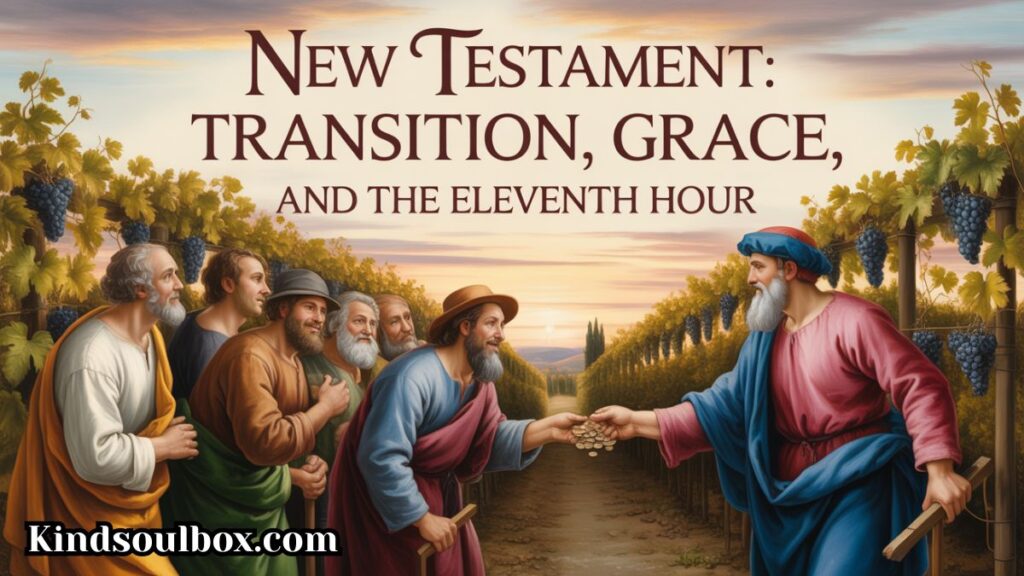
The Parable of the Eleventh Hour (Matthew 20:1-16)
Jesus Christ told a provocative parable about vineyard workers hired throughout the day. Some began at dawn, others at mid-morning, noon, mid-afternoon, and finally, some were hired “about the eleventh hour” (Matthew 20:9).
When evening came, all received the same payment—a full day’s penny (denarius). The early workers protested. The landowner responded: “Is it not lawful for me to do what I wish with my own things? Or is your eye evil because I am good?” (Matthew 20:15).
The eleventh hour represents grace. Those who worked one hour received the same reward as those who labored twelve. This challenged conventional thinking about fairness and merit.
Spiritual meaning flows from this parable. God’s grace doesn’t operate on human accounting systems. Whether someone follows Christ from childhood or receives Him on their deathbed, eternal life comes through faith, not accumulated good works.
The eleventh hour also suggests urgency. It’s late—but not too late. Redemption remains available even when time seems almost exhausted.
The Love of Money (1 Timothy 6:10)
Apostle Paul wrote to Timothy with urgent warnings about false teaching and idolatry: “For the love of money is a root of all kinds of evil, for which some have strayed from the faith in their greediness, and pierced themselves through with many sorrows” (1 Timothy 6:10).
This verse—1 Timothy 6:10—contains both six (humanity’s number, falling short of seven’s perfection) and ten (God’s law). The warning addresses how money-love creates disorder in individual lives and church communities.
Notice Paul didn’t condemn money itself. He condemned the love of money—making it an idol, prioritizing it above God, allowing it to master your heart.
The root of all evil isn’t currency. It’s displaced worship. When anything supplants God’s rightful place, confusion and chaos follow. James echoed this: “For where envy and self-seeking exist, confusion and every evil thing are there” (James 3:16).
This connects to eleven’s symbolism. Disorder in priorities produces disorder in life. Financial idolatry represents one manifestation of the broader rebellion pattern seen throughout Scripture.
The Eleven Apostles (Matthew 28, Mark 16, Luke 24, Acts 1)
After Judas Iscariot’s betrayal and suicide, the apostles numbered eleven. This wasn’t just a factual detail—it was theologically significant.
Jesus appeared to “the eleven” multiple times post-resurrection:
- Matthew 28:16: “Then the eleven disciples went away into Galilee.“
- Mark 16:14: “Later He appeared to the eleven as they sat at the table.“
- Luke 24:33: “they found the eleven… gathered together.“
Eleven represented incompleteness. The twelve apostles symbolized God’s governmental structure—paralleling the twelve guilds. With Judas gone, that structure stood fractured.
But God doesn’t leave brokenness unaddressed. In Acts 1:26, the remaining apostles cast lots between Joseph and Matthias: “And the lot fell on Matthias. And he was numbered with the eleven apostles.“
Restoration. Completeness regained. The eleven apostles became twelve again.
This pattern matters profoundly. Betrayal creates disorder, but God provides redemption and restoration. The uncomfortable eleven-season gives way to renewed twelve-structure. Galatians 1:1 later shows Paul claiming apostleship too—God’s government expanding rather than merely replacing.
Prophetic Significance: Eleven in End-Times Prophecy
The Eleventh Horn in Daniel’s Vision (Daniel 7:24)
The prophet Daniel received disturbing visions about future kingdoms and their rulers. In Daniel 7, he saw ten horns representing ten kings. Then: “another shall rise after them; he shall be different from the first ones, and shall subdue three kings” (Daniel 7:24).
This eleventh horn—the “little horn”—represents a future ruler many scholars identify with the Antichrist figure mentioned in Revelation. This ruler embodies disorder, confusion, and rebellion against God’s sovereignty on an unprecedented scale.
The symbolism aligns perfectly with eleven’s established meaning:
- Disrupts existing order (defeats three of the ten kings)
- Exalts himself against God (speaks pompously)
- Persecutes God’s people (wages war against the saints)
- Changes times and laws (attempts to alter divine order)
This prophecy suggests that eleven’s pattern will reach ultimate fulfillment in end-times events. The temporary chaos before God’s final judgment and establishment of His eternal kingdom.
Eleven Dukes of Edom (Genesis 36:40-43)
Genesis lists the descendants of Esau: “And these were the names of the chiefs of Esau… Chief Timnah, Chief Alvah, Chief Jetheth…” totaling eleven chiefs (dukes) ruling Edomite territories.
The Edomites descended from Esau, Jacob’s brother, who despised his birthright. They became perpetual enemies of Israel, representing opposition to God’s chosen people and purposes.
Eleven chiefs governing Edom symbolized incomplete authority—falling short of the twelve-league structure God established for Israel. This numerical difference underscored the spiritual distinction between God’s chosen nation and those opposing His plans.
Satan and the Number of Opposition
The Connection to Rebellious Angels
While Scripture doesn’t explicitly call eleven “Satan’s number,” patterns emerge connecting this number to opposition against God.
Satan represents the ultimate rebel—an angel who rejected his created purpose, attempting to elevate himself above God. His work throughout Scripture consistently involves:
- Creating confusion where God established clarity
- Introducing disorder where God created order
- Promoting rebellion against divine authority
- Fracturing unity among God’s people
These align precisely with eleven’s symbolic meaning. When eleven appears in Scripture, it frequently involves satanic opposition—directly or indirectly:
- Genesis 6:11: Earth’s corruption reflects Satan’s influence since Eden
- Tower of Babel: Human pride inspired by the original prideful rebellion
- Betrayals by Delilah and Judas: Satan working through human agents
Jesus Himself identified Satan’s work: “The thief does not come except to steal, and to kill, and to destroy. I have come that they may have life, and that they may have it more abundantly” (John 10:10).
Christ as the Cornerstone: The Stumbling Number
1 Peter 2:6-8 quotes Isaiah about Christ: “Behold, I lay in Sion a chief cornerstone, elect, precious… a stone of stumbling and a rock of offense.“
This cornerstone represents perfect order—the foundation upon which everything aligns. But to unbelievers, Christ becomes a stumbling block, a rock of offense, creating confusion rather than clarity.
Apostle Paul wrote: “but we preach Christ crucified, to the Jews a stumbling block and to the Greeks foolishness” (1 Corinthians 1:23).
The world’s rejection of Christ creates the ultimate eleven-pattern: humanity choosing disorder (rejection of the cornerstone) over divine order (building on God’s foundation).
Practical Application: Understanding Eleven in Your Life Today
Recognizing Disorder and Transition Seasons
Understanding God’s Word through patterns like eleven helps you recognize similar seasons in your personal spiritual growth.
Have you experienced periods where:
- Life felt unstable, caught between what was and what’s coming.
- Previous structures collapsed, leaving you uncertain?
- Disobedience produced consequences requiring painful adjustment?
- Waiting seemed endless before restoration arrived.
These reflect eleven patterns. They’re uncomfortable, often painful, but purposeful. God uses them to:
1. Expose hidden issues – Disorder reveals what needs addressing. Comfortable routines can mask spiritual problems that chaos exposes.
2. Test and strengthen faith – Like Israel’s eleven-day journey becoming forty years, these seasons test whether you’ll trust God’s character despite circumstances.
3. Prepare for new chapters – The eleven apostles needed time processing grief, experiencing resurrection appearances, and receiving instructions before becoming twelve again.
4. Drive dependence on God – When your own efforts prove insufficient, you learn to rely on divine intervention rather than self-sufficiency.
From Eleven to Twelve: The Pattern of Restoration
Scripture consistently shows God restoring order from chaos:
| Disorder (11) | Divine Response | Restored Order (12) |
|---|---|---|
| Eleven apostles after betrayal | Selection of Matthias | Twelve apostles restored |
| Joseph was separated from his eleven brothers | Elevation in Egypt, family reunion | Twelve tribes formed |
| Jehoiakim and Zedekiah’s combined reigns (22 years = 11+11) | Babylonian exile, purification | Remnant returns, temple rebuilt |
| Eleven-day journey extended to forty years | Wilderness generation dies | New generation enters Canaan |
Your eleven seasons aren’t final destinations. They’re transitions. God hasn’t abandoned you in the confusion. He’s preparing you for restoration.
Faith during disorder looks like:
- Trusting God’s character when circumstances seem contradictory
- Maintaining obedience despite delayed results
- Refusing idolatry (false solutions, unhealthy coping mechanisms)
- Remaining connected to worship and community
- Studying biblical patterns to gain perspective
Avoiding Numerology Obsession
A critical caution: Don’t become superstitious about numbers. Biblical numerology enriches Scripture study—it doesn’t replace sound interpretation or relationship with Christ.
Some people see 11:11 on clocks and attribute mystical significance. Others avoid certain numbers as “unlucky.” This misses the point entirely.
Numbers in Scripture reveal God’s sovereignty and design. They’re not magical formulas or cosmic codes requiring deciphering. The spiritual lessons matter more than the digits themselves.
Focus on:
- What Scripture teaches about God’s character
- How patterns reveal His consistent nature
- Why disorder matters in understanding human rebellion
- Where restoration comes from (God alone, through Christ)
Don’t date-set based on numbers. Don’t make major decisions because eleven appeared somewhere. don’t develop anxiety about numerical patterns.
Instead, let biblical numerology deepen your appreciation for Scripture’s coherence and God’s intentional design throughout human history.
Conclusion
What does the number 11 mean in the Bible? It reveals disorder, judgment, and incompleteness throughout Scripture. What Does the Number 11 Mean in the Bible? From Babel’s confusion to the eleven apostles after betrayal, this number marks transitions between rebellion and restoration. What Does the Number 11 Mean in the Bible? God consistently transforms chaos into order, proving His sovereignty never wavers despite human failure.
What does the number 11 mean in the Bible for believers today? It offers hope during difficult seasons. What Does the Number 11 Mean in the Bible? Your uncomfortable transitions aren’t abandonment—they’re preparation. Like Israel’s eleven-day journey or the eleven apostles becoming twelve again, restoration follows disorder. What Does the Number 11 Mean in the Bible? Trust God’s character. What Does the Number 11 Mean in the Bible? He specializes in bringing order from chaos through Christ’s redeeming grace. What Does the Number 11 Mean in the Bible?
FAQs
Is the number 11 cursed or evil in the Bible?
No, eleven isn’t cursed. It represents disorder and incompleteness in biblical patterns, reflecting human rebellion against God’s order, not evil in the number itself.
How many times does the number 11 appear in the Bible?
Eleven appears throughout Scripture in Genesis 6:11, Genesis 11 (Tower of Babel), Exodus 26:7-8 (curtains), Judges 16:5 (silver pieces), two kings’ eleven-year reigns, and references to the eleven apostles after Judas’s betrayal.
What’s the difference between 11 and 12 in biblical meaning?
Twelve represents God’s complete governmental structure (12 crews, 12 apostles), while eleven represents incompleteness and disorder—the uncomfortable gap between what was and what will be restored.
Should Christians avoid the number 11?
No, avoiding eleven is superstition, not biblical faith. Understanding what it represents in Scripture enriches Bible study without creating fear or magical thinking about numbers.
Does seeing 11:11 on clocks have spiritual meaning?
No, repeatedly seeing 11:11 is a modern coincidence unrelated to biblical numerology. God speaks through His Word, prayer, and the Holy Spirit—not through digital clock patterns.