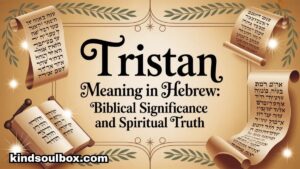
Tristan meaning in Hebrew explores the spiritual connections between this popular name and biblical themes, despite its actual Celtic and Old French origins. While Tristan doesn’t appear in Scripture or carry authentic Hebrew etymology, understanding its biblical significance helps parents discover how traditional meanings like sorrow, tumult, and warrior spirit align with powerful scriptural patterns of redemption and transformation.
Parents choosing Tristan often feel torn between loving the name and desiring spiritual depth. The tension dissolves when you realize God transforms ordinary names into prophetic declarations through faith and intention, just as He changed Abram to Abraham and Jacob to Israel.
This comprehensive guide reveals how Tristan’s traditional meanings—sorrow becoming strength, chaos finding peace, warriors serving humbly—mirror central biblical narratives. You’ll discover legitimate spiritual significance without false claims about Hebrew roots, empowering you to bless your Tristan with authentic Christian tradition and scriptural truth that shapes identity and destiny.
The True Etymology: Where Tristan Really Comes From

Tristan carries Celtic and Old French heritage, not Hebrew. Understanding this distinction matters for authenticity.
Celtic Britain Origins
The name traces back to Pictish culture in Ancient Britain. Scholars link it to “Drust” or “Drustan,” names borne by early Celtic warriors. These names likely meant “riot,” “tumult,” or “bold one.” The Celtic language emphasized strength and courage in naming traditions.
King Drust appears in Pictish king lists from the 6th and 7th centuries. Warriors bearing this name embodied fierce loyalty and battlefield prowess. The transformation from Drust to Tristan occurred as stories traveled through cultures.
Old French Transformation
Medieval legend popularized the Old French variant “Tristan,” derived from “triste,” meaning “sorrowful” or “sad.” The famous Tristan and Isolde tale cemented this association. By the 12th century, the name had evolved into the form we recognize today.
| Original Form | Language | Meaning | Era |
|---|---|---|---|
| Drust/Drustan | Celtic/Pictish | Tumult, bold | 5th-7th century |
| Tristan | Old French | Sorrowful, sad | 12th century onward |
| Tristan | Modern English | Sorrow/tumult | Contemporary |
The name’s meaning shifted from warrior boldness to romantic sadness under the influence of literature. Neither version connects to Hebrew etymology or biblical tradition.
Why People Search for Hebrew Connections
Modern parents increasingly seek biblical significance in names. This creates confusion when Western names like Tristan don’t have Hebrew roots. Several factors drive this search:
Spiritual naming trends cross religious boundaries. Christian families want names reflecting faith values. Some assume all meaningful names must be biblical. The internet amplifies this confusion through poorly researched articles.
Name origin doesn’t determine spiritual value, though. Christopher means “Christ-bearer” but comes from Greek. Grace, Faith, and Hope are English virtue names. Your child’s character matters infinitely more than linguistic pedigree.
Is Tristan Found in the Bible?

Let’s address this directly: No biblical character bears the name Tristan. Neither the Hebrew Bible (Old Testament) nor the New Testament contains this name or close variants.
Hebrew Scripture Check
The Old Testament features hundreds of names: Abraham, David, Joseph, Daniel, Ezekiel, and countless others. Not one resembles Tristan phonetically or etymologically. Hebrew naming patterns follow specific structures foreign to Celtic/French conventions.
Common Hebrew names include:
- Elijah (אֵלִיָּהוּ) – “My God is Yahweh.”
- Joshua (יְהוֹשֻׁעַ) – “Yahweh is salvation”
- Gabriel (גַּבְרִיאֵל) – “God is my strength”
- David (דָּוִד) – “Beloved”
Notice how Hebrew names typically incorporate divine references or character qualities. Tristan lacks this theological structure entirely.
New Testament Analysis
Greek manuscripts of the New Testament also contain zero references to Tristan. Early Christian tradition adopted many Hebrew names (Jesus, Paul, Peter), plus Greek names (Timothy, Titus) and Latin names (Marcus, Rufus).
The apostolic era (1st century AD) predates medieval legend by a millennium. Tristan and Isolde emerged in 12th-century romance literature, long after the biblical canon closed. Christian name adoption of Tristan came through European culture, not Scripture.
Addressing Common Misconceptions
Some websites incorrectly claim that Tristan has a Hebrew meaning. This represents either deliberate misinformation or confused research. Hebrew and Jewish cultures were unaware of this name until modern cross-cultural exchange.
If you’re searching for authentic Hebrew-inspired names, consider actual biblical options. But if Tristan resonates with you, don’t let non-Hebrew origin discourage you. We’ll explore how to infuse it with spiritual meaning legitimately.
Hebrew Words That Echo Tristan’s Themes
While Tristan isn’t Hebrew, certain biblical concepts beautifully parallel its traditional meanings. Let’s explore these connections honestly.
Sorrow and Suffering
Tristan’s association with sorrow finds powerful echoes in Hebrew vocabulary. The word “yagon” (יָגוֹן) means grief or sorrow. Scripture uses it extensively:
“You have turned my mourning into dancing; you have loosed my sackcloth and clothed me with gladness” (Psalm 30:11). This verse captures the transformation from sorrow to strength that defines biblical hope.
Another Hebrew term, “amal” (עָמָל), describes toil and hardship. Job experienced profound “amal” yet declared: “Though He slay me, yet will I trust Him” (Job 13:15). Endurance through suffering produces resilience.
Tumult and Chaos
The meaning “tumult” or chaos connects to Hebrew words like “mehumah” (מְהוּמָה) and “sa’ar” (סַעַר), meaning storm or tempest. Consider how Jesus Christ calmed the storm in Mark 4:39: “Peace, be still!”
Tumult to peace represents a core biblical pattern. Joseph experienced slavery, false accusation, and imprisonment before becoming Egypt’s second ruler. His tumult transformed into divine purpose.
| Tristan Theme | Hebrew Concept | Hebrew Word | Scripture Example |
|---|---|---|---|
| Sorrow | Grief transformed | Yagon (יָגוֹן) | Psalm 30:11 |
| Tumult | Storm to calm | Sa’ar (סַעַר) | Mark 4:39 |
| Strength | Might/courage | Oz (עֹז) | Joshua 1:9 |
| Loyalty | Faithfulness | Emunah (אֱמוּנָה) | Lamentations 3:22-23 |
Warrior Spirit
Celtic Tristan meant “bold warrior.” Hebrew captures this with “gibbor” (גִּבּוֹר) meaning mighty one. King David epitomized the warrior spirit. His mighty men demonstrated extraordinary courage (2 Samuel 23).
Yet biblical warriors served higher purposes. David wrote: “Some trust in chariots and some in horses, but we trust in the name of the LORD our God” (Psalm 20:7). Strength flows from faith, not mere physical prowess.
Spiritual meaning transforms warrior imagery. Paul the Apostle wrote about spiritual warfare: “For we do not wrestle against flesh and blood” (Ephesians 6:12). Courage battles doubt, fear, and despair.
Bold and Brave
Hebrew names like Oz (עֹז – strength), Geber (גֶּבֶר – strong man), and Amatz (אָמַץ – to be strong) parallel Tristan’s warrior connotations. God’s Word repeatedly commands courage:
“Be strong and courageous. Do not be afraid or terrified… for the LORD your God goes with you” (Joshua 1:9). True boldness comes from divine presence, not human bravado.
Biblical Themes That Align With Tristan

Though Tristan lacks a Hebrew origin, powerful biblical patterns mirror its meanings. These connections offer authentic spiritual significance.
Sorrow to Strength: The Redemption Pattern
Scripture overflows with sorrow-to-strength narratives. This theme defines redemption itself.
Joseph’s story exemplifies complete transformation. Brothers sold him into slavery, motivated by jealousy. He endured false accusations from Potiphar’s wife and years in Egyptian prison. Yet Genesis 50:20 reveals divine purpose: “You intended to harm me, but God intended it for good to accomplish what is now being done, the saving of many lives.”
Joseph’s sorrow became national salvation. His resilience preserved Israel during famine. Parents naming their son Tristan can declare this same pattern: present sorrow prepares for future strength.
Psalm 30:5 promises: “Weeping may endure for a night, but joy comes in the morning.” This isn’t toxic positivity dismissing pain. It’s faith, trusting God’s Word beyond current circumstances.
Paul the Apostle demonstrated this principle powerfully. He wrote 2 Corinthians 12:9-10: “My grace is sufficient for you, for my power is made perfect in weakness… For when I am weak, then I am strong.” Divine strength manifests through human sorrow and limitation.
Consider how this applies practically:
- Suffering develops character (Romans 5:3-5)
- Trials produce endurance and maturity
- Weakness creates dependence on God
- Past sorrow equips you to comfort others (2 Corinthians 1:3-4)
Tumult to Peace: Divine Calm in Chaos
Tristan’s “tumult” meaning finds resolution in biblical peace passages. The disciples experienced literal storms and metaphorical chaos.
Mark 4:37-39 describes a furious squall threatening to sink their boat. Jesus slept peacefully while they panicked. “He got up, rebuked the wind and said to the waves, ‘Quiet! Be still!’ Then the wind died down, and it was completely calm.”
Tumult to peace isn’t circumstances changing magically. It’s trust displacing anxiety. Philippians 4:6-7 instructs: “Do not be anxious about anything, but in every situation, by prayer and petition, with thanksgiving, present your requests to God. And the peace of God, which transcends all understanding, will guard your hearts.”
Paul experienced shipwreck, imprisonment, beatings, and constant danger. Yet he called himself content in all circumstances (Philippians 4:11-13). External tumult couldn’t disturb the internal peace rooted in Christ.
Modern parents naming their child Tristan can prophesy this same stability. Your son or daughter will face life’s storms. Grounding them in faith provides unshakeable peace amid chaos.
Warrior to Servant: Biblical Leadership Model
Celtic Tristan embodied warrior qualities. Biblical significance reframes this as servant leadership.
King David transitioned from shepherd to warrior to king. 1 Samuel 17 shows young David defeating Goliath through faith, not military training. He became Israel’s greatest king, yet his Psalms reveal a tender heart toward God.
Jesus Christ provided the ultimate example. Philippians 2:6-8 explains: “Who, being in very nature God, did not consider equality with God something to be used to his own advantage; rather, he made himself nothing by taking the very nature of a servant.”
True strength serves others sacrificially. Matthew 20:28 records Jesus saying: “The Son of Man did not come to be served, but to serve, and to give his life as a ransom for many.”
Tristan can represent this transformation:
- From a warrior defending oneself to a servant protecting others
- From bold independence to humble dependence
- From tumult creating to peace establishing
- From a strength glorifying self to a strength honoring God
Passionate Love to Divine Love
Medieval legend portrays Tristan and Isolde’s passionate love as adulterous and destructive. Biblical love offers a radical contrast.
1 Corinthians 13:4-7 defines authentic love: “Love is patient, love is kind… It always protects, always trusts, always hopes, always perseveres.” This contradicts selfish, passionate love consuming everything.
Ephesians 5:25 commands husbands: “Love your wives, just as Christ loved the church and gave himself up for her.” Divine love sacrifices for others’ benefit. Passionate love takes for personal pleasure.
The Tristan legend violates Exodus 20:14 (“You shall not commit adultery”) and Hebrews 13:4 (“Marriage should be honored by all, and the marriage bed kept pure”). Christian tradition rejects this narrative.
Yet parents can reclaim Tristan by declaring divine love over passionate love. Teach your Tristan about covenant faithfulness, not fleeting feelings. Model 1 John 4:19: “We love because he first loved us.”
Loyalty to Faithfulness
Loyalty represented a core Tristan virtue in medieval legend. Scripture elevates this to faithfulness.
Lamentations 3:22-23 declares: “Because of the LORD’s great love we are not consumed, for his compassions never fail. They are new every morning; great is your faithfulness.” God models perfect loyalty.
Ruth demonstrated extraordinary faithfulness to Naomi: “Where you go I will go, and where you stay I will stay. Your people will be my people and your God my God” (Ruth 1:16). This loyalty resulted in Ruth becoming King David’s great-grandmother and ancestor of Jesus Christ.
Jonathan showed covenant loyalty to David despite his father Saul’s murderous jealousy (1 Samuel 18-20). Biblical faithfulness endures opposition and cost.
Parents can prophesy faithfulness over children named Tristan:
- Loyalty to God above all
- Faithfulness in friendships and marriage
- Endurance through trials
- Covenant-keeping character
Spiritual Significance for Modern Believers
Tristan’s meaning in Hebrew searches often really ask: “Can this name carry spiritual meaning?” Absolutely yes, but not through false etymologies.
Christian Perspective on Non-Hebrew Names
Most Christian names aren’t Hebrew. Consider these beloved options:
Christopher (Greek: “Christ-bearer”), Grace (English virtue name), Faith (English), Hope (English), Sophia (Greek: “wisdom”), Nicholas (Greek: “victory of the people”), Catherine (Greek: “pure”), Patrick (Latin: “nobleman”).
Biblical significance doesn’t require Hebrew origin. Character and faith matter supremely. Proverbs 22:1 teaches: “A good name is more desirable than great riches; to be esteemed is better than silver or gold.”
Your child’s name becomes meaningful through how they live, not linguistic roots. A boy named Tristan, who demonstrates courage, faithfulness, and endurance, honors God more than someone with a biblical name who lacks character.
Jewish Cultural Perspective
Jewish culture maintains specific naming traditions. Ashkenazi Jews traditionally name children after deceased relatives. Sephardic Jews name after living relatives. Both groups value Hebrew names, connecting children to Jewish heritage.
Tristan wouldn’t typically appear in observant Jewish families. It’s culturally foreign, though not offensive. Hebrew culture respects authenticity. If you’re not Jewish, don’t appropriate Jewish traditions by falsely claiming Tristan has a Hebrew meaning.
Respectful appreciation differs from cultural theft. Admiring Hebrew name symbolism while honestly acknowledging Tristan’s Celtic roots demonstrates integrity.
Creating Spiritual Meaning Through Intention
Names acquire spiritual significance through parental dedication and purpose. Here’s how to infuse Tristan with deep meaning:
Speak prophetic blessing: Declare biblical truths over your child. “Tristan, you will turn sorrow to strength through Christ’s power. Your life will bring peace to chaos. You’ll serve others with warrior courage.”
Choose meaningful middle names: Pair Tristan with biblical names. Tristan Elijah, Tristan Gabriel, Tristan David, Tristan Joseph. This honors both Christian tradition and personal preference.
Teach the redemption narrative: Explain how God transforms suffering into glory. Connect Tristan’s “sorrow” meaning to Jesus Christ’s crucifixion and resurrection. Death became life. Sorrow became salvation.
Model character: Children learn more from observation than explanation. Demonstrate resilience, faithfulness, and courage. Your Tristan will embody these qualities by watching you.
Tristan in Legend vs Christian Truth

The Tristan and Isolde legend directly contradicts biblical morality. Understanding this tension helps parents reclaim the name righteously.
The Medieval Romance Story
12th-century French poet Thomas wrote the definitive Tristan and Isolde tale. Tristan, a Cornish knight, escorts Irish princess Isolde to marry his uncle, King Mark. They accidentally drink a love potion and begin an adulterous affair. The story ends tragically with both lovers dying.
Medieval legend romanticizes sin. The narrative portrays passionate love as an irresistible fate, excusing adultery. Characters become victims of destiny rather than moral agents making choices.
This contradicts Scripture fundamentally. Galatians 6:7-8 warns: “Do not be deceived: God cannot be mocked. A man reaps what he sows. Whoever sows to please their flesh, from the flesh will reap destruction.”
Biblical Counterpoints
Joseph provides a powerful contrast (Genesis 39). Potiphar’s wife repeatedly seduced him. Joseph refused, declaring: “How then could I do such a wicked thing and sin against God?” He fled temptation, suffering false imprisonment as a result.
Proverbs repeatedly warns against adultery. Proverbs 6:27-29 asks: “Can a man scoop fire into his lap without his clothes being burned?… So is he who sleeps with another man’s wife.”
Jesus taught absolute morality, not moral relativism. Matthew 5:28 states: “Anyone who looks at a woman lustfully has already committed adultery with her in his heart.” Passionate love outside covenant marriage equals sin.
The Tristan legend ultimately brings destruction. Biblical wisdom brings life (Proverbs 13:22).
Redeeming the Name
Parents can separate the name from the narrative. Tristan need not carry medieval legend baggage. Consider how to redeem it:
Reframe the story: “Tristan means sorrow transformed to strength. Like Joseph, Paul, and Jesus, sorrow becomes purpose through faith.”
Emphasize different qualities: Focus on warrior courage, loyalty, and boldness. Ignore the adulterous romance angle completely.
Teach biblical sexuality: As your child matures, discuss covenant love versus selfish, passionate love. Use Tristan and Isolde as a cautionary tale, not an ideal.
Live differently: Model faithful marriage. Show your Tristan what divine love looks like practically. Actions speak louder than ancient legends.
Name Symbolism in Hebrew Thought
Hebrew culture views names as prophetic declarations shaping identity and destiny. This principle applies beyond Hebrew names themselves.
The Power of Names in Scripture
God changed Abram (“exalted father”) to Abraham (“father of many nations”) in Genesis 17:5. The name shift preceded fulfillment. Abraham became the father of Isaac before becoming the father of nations.
Sarai became Sarah (Genesis 17:15). Jacob (“supplanter”) became Israel (“struggles with God“) after wrestling the angel (Genesis 32:28). Simon became Peter (“rock”) when Jesus declared his future role (Matthew 16:18).
Names carry prophetic weight. They declare what children will become, not just what they are.
Applying This Principle to Tristan
Though Tristan isn’t Hebrew, the same principles apply. Your name declarations shape identity:
Negative declaration: “Tristan means sorrow. Life will be hard for you.” This creates limiting beliefs and a victim mentality.
Positive declaration: “Tristan means God transforms sorrow to strength. You’ll develop resilience through challenges. Your tumult will become peace as you trust Christ.”
See the difference? Same name, radically different prophetic meaning.
Speaking Life Over Your Tristan
Proverbs 18:21 teaches: “The tongue has the power of life and death.” Speak life over your child:
Annual birthday blessings: Each year, pray Scripture over your Tristan. Declare Philippians 4:13: “Tristan, you can do all things through Christ who strengthens you.”
Daily affirmations: Regularly say: “You are bold as a lion (Proverbs 28:1). You have a spirit of power, love, and self-discipline (2 Timothy 1:7). God’s plans for you are good (Jeremiah 29:11).”
Crisis moments: When suffering comes, remind them: “This sorrow is temporary. God is transforming it to strength (Romans 8:28). Your tumult will birth purpose.”
Practical Guidance for Parents Considering Tristan
Choosing a name carries significant weight. Here’s wisdom for parents drawn to Tristan.
Questions to Consider
Does it honor your faith values? Yes, if you frame it through biblical transformation themes rather than medieval legend adultery.
Can you assign redemptive meaning? Absolutely. Sorrow to strength, tumult to peace, warrior to servant—these align beautifully with Scripture.
How will you explain it? Prepare a clear narrative: “Tristan comes from Celtic roots, meaning bold and sorrow. We chose it because God transforms sorrow to strength, tumult to peace. Your name declares God’s redemption power.”
What about the community reception? Most people won’t know the Tristan and Isolde legend. Those who do can hear your redemptive framing. Don’t let fear of judgment override your conviction.
Meaningful Combinations
Pairing Tristan with biblical middle names creates spiritual depth:
- Tristan Elijah – “Sorrow transformed” + “My God is Yahweh”
- Tristan Gabriel – “Bold one” + “God is my strength“
- Tristan David – “Warrior” + “Beloved.“
- Tristan Joseph – “Tumult” + “He will add”
- Tristan Samuel – “Sorrow” + “Heard by God“
These combinations honor both personal preference and biblical heritage.
Sample Blessing for Your Tristan
Create a personal blessing based on Scripture:
“Tristan, we declare over you Psalm 30:11: God will turn your mourning into dancing. Your sorrow will become strength. Like Joseph, your struggles will birth divine purpose.
We pray Joshua 1:9 over you: Be strong and courageous. Do not be afraid, for the Lord your God goes with you.
May you embody 2 Corinthians 12:9: When you are weak, then Christ’s strength perfects you. Your tumult will teach you peace. Your warrior spirit will serve others humbly.
We dedicate you to Jesus Christ, who transforms sorrow to joy, death to life, and sinners to saints. May your name declare His redemption power always. Amen.”
Conclusion
Tristan meaning in Hebrew reveals an important truth: authentic biblical significance doesn’t require Hebrew origins. Tristan Meaning in Hebrew. While Tristan comes from Celtic roots, its themes of sorrow-to-strength and tumult-to-peace mirror powerful scriptural patterns. Tristan Meaning in Hebrew. Parents can confidently choose this name while honoring Christian tradition through intentional blessing and faith-filled declarations over their children. Tristan Meaning in Hebrew.
Understanding the meaning in Hebrew searches ultimately teaches us that spiritual truth transcends etymology. Tristan Meaning in Hebrew. Your child’s character matters infinitely more than linguistic pedigree. Speak biblical promises over your Tristan. Tristan Meaning in Hebrew. Model Christ-like virtues. Create a legacy of transformation and redemption. Tristan Meaning in Hebrew. That’s how names acquire genuine biblical significance and lasting spiritual power.
FAQs
Does Tristan have a Hebrew meaning?
No, Tristan originates from Celtic and Old French roots, meaning “sorrow” or “tumult.” It has no Hebrew linguistic connection or etymology.
Is Tristan mentioned anywhere in the Bible?
Tristan appears nowhere in Scripture. Neither the Old Testament nor the New Testament contains this name or any similar variants.
Can Christians use the name Tristan?
Absolutely. Most Christian names aren’t Hebrew (like Grace, Faith, Christopher). What matters is raising your child with biblical values and character.
What biblical theme best matches Tristan’s meaning?
The sorrow-to-strength transformation seen in Joseph’s story and Paul’s writings in 2 Corinthians 12:9-10 perfectly mirrors Tristan’s traditional meaning.
How can I give Tristan spiritual significance?
Pair it with biblical middle names (Tristan David, Tristan Elijah), speak scriptural blessings over your child, and model Christ-like character daily.