The Bible verse that says “joy comes in the morning” refers to Psalm 30:5, where King David declares that weeping may endure for a night, but joy comes with the dawn. This powerful scripture promises that suffering is temporary while God’s favour lasts forever.
Picture a mother clutching her phone at 4 a.m., reading these seven words through tears after losing her job. Three months later, she landed her dream position. That’s not a coincidence—that’s the transformative power of biblical promises manifesting in real life.
Millions of believers worldwide cling to Psalm 30:5 during their darkest seasons. This verse doesn’t just offer hollow comfort—it reveals God’s redemptive pattern throughout history. From Joseph‘s prison cell to Christ’s resurrection morning, Scripture proves that every night of weeping carries an appointment with joy. Your breakthrough isn’t a matter of if, but when.
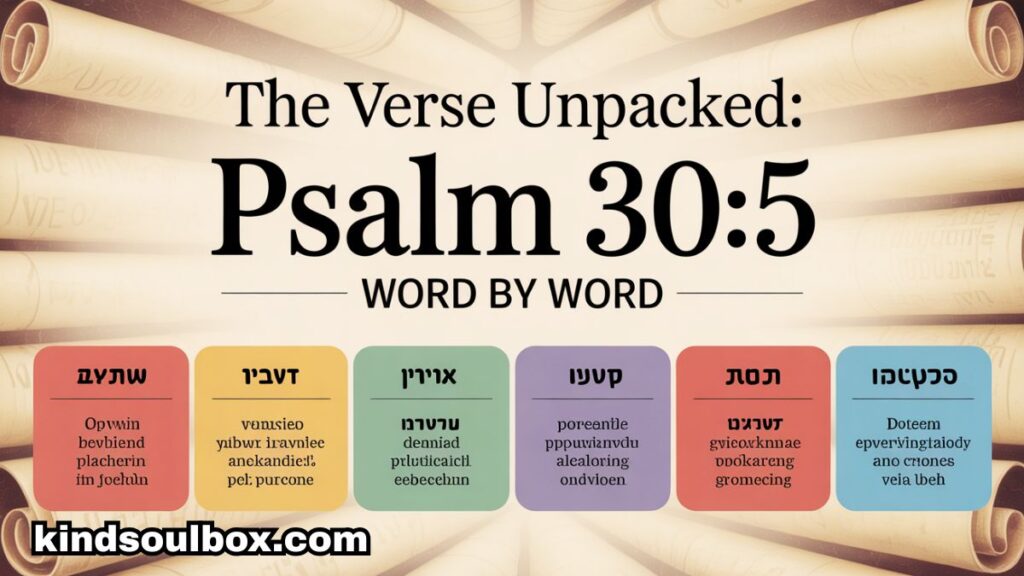
The Verse Unpacked: Psalm 30:5 Word by Word
Let’s look at the exact Bible verse about joy in three major translations:
| Translation | Full Text |
| KJV | “For his anger endureth but a moment; in his favour is life: weeping may endure for a night, but joy cometh in the morning.” |
| NIV | “For his anger is but for a moment, and his favour is for a lifetime. Weeping may tarry for the night, but joy comes with the morning.” |
| ESV | “For his anger is but for a moment, and his favor is for a lifetime. Weeping may tarry for the night, but joy comes with the morning.” |
The Psalm 30:5 meaning becomes clearer when we examine the Hebrew words:
“Weeping” (bekiy) doesn’t mean polite tears. It describes gut-wrenching sobs, the kind that shake your entire body. This is grief that feels like it’ll never end.
“Endure” (luwn) literally means “to lodge overnight” or “to spend the night.” Your sorrow is a temporary guest, not a permanent resident.
“Night” (ereb) represents seasons of hardship, not just literal darkness. In ancient Hebrew culture, night symbolised danger, uncertainty, and separation from God’s favour.
“Joy” (rinnah) means a loud cry of triumph. This isn’t quiet contentment—it’s shouting-from-the-rooftops happiness.
“Morning” (boqer) signifies new beginnings, restoration, and the breaking of light through darkness.
Here’s what people get wrong: This verse doesn’t promise your circumstances will change overnight. It promises that God’s faithfulness outlasts your pain. The contrast isn’t between a sad evening and a happy morning—it’s between temporary suffering and everlasting love.
David’s Story: Why He Wrote These Words

King David didn’t write Psalm 30 from a palace balcony on a peaceful afternoon. He wrote it after staring death in the face.
The heading reads: “A Song of Thanksgiving at the Dedication of the House of David.” Scholars believe David penned this after recovering from a life-threatening illness that nearly killed him. Some ancient Jewish traditions suggest he wrote it when he purchased the threshing floor that would become the Temple site—a moment of triumph after a political crisis.
Here’s David’s journey in this psalm:
- Verse 1-3: “I cried to you for help, and you healed me. You brought me up from the grave.”
- Verse 6-7: “When I felt secure, I said, ‘Nothing can shake me.’ But you hid your face, and I was dismayed.”
- Verse 11-12: “You turned my wailing into dancing. You removed my sackcloth and clothed me with joy.”
David experienced what therapists now refer to as the “night of the soul.” His wealth couldn’t save him. His army couldn’t fight this battle. his crown meant nothing. On that night of weeping, David discovered something profound: God’s anger is momentary, but His favour spans a lifetime.
The historical context matters. David wrote during Israel’s united monarchy, roughly 1000 BCE. People understood night differently than we do. No electric lights. No smartphones to distract from the darkness. When the sun set, danger increased. Wild animals are hunted. Enemies attacked. Night was legitimately terrifying.
But morning? Morning meant safety returned. Light-exposed threats. Work could resume. Hope was reborn.
David transformed his personal restoration into a universal principle: Your weeping has an expiration date.
The Theology Behind the Promise

Why does weeping endure for a night but joy comes in the morning? Because of God’s character.
The verse starts with “For his anger endureth but a moment.” God’s discipline is temporary and purposeful. His favour is permanent and generous. Look at the math:
Anger: A moment
Favour: A lifetime
That’s not even close. God’s grace wins by an eternity.
This connects to resurrection theology throughout Scripture. Consider these parallel patterns:
- Joseph: Thrown in a pit by his brothers (night), became Egypt’s second-in-command (morning) – Genesis 37-41
- Job: Lost everything, including his health (night), received double restoration (morning) – Job 42:10
- The Israelites: Enslaved in Egypt for 400 years (night), delivered through the Red Sea (morning) – Exodus 14
- Jesus: Crucified and buried (Friday night), resurrected in victory (Sunday morning) – Matthew 28
The pattern repeats because God operates on a morning principle. He specialises in new beginnings.
Isaiah 61:3 echoes this promise: God gives “beauty for ashes, the oil of joy for mourning, the garment of praise for the spirit of heaviness.”
Lamentations 3:22-23 adds: “His compassions fail not. They are new every morning: great is thy faithfulness.”
John 16:20 records Jesus saying: “You will weep and mourn while the world rejoices. You will grieve, but your grief will turn to joy.”
The divine morning isn’t just about personal happiness. It’s about God’s redemptive work in history. Every resurrection morning throughout Scripture points to the ultimate Morning—when Christ returns and wipes every tear from our eyes (Revelation 21:4).
Real Stories: Joy That Actually Came in the Morning

Hannah’s Story
Hannah endured years of barrenness and mockery. Her rival taunted her daily. She wept bitterly in the temple, so distraught that the priest thought she was drunk (1 Samuel 1). Her night lasted years.
Then came her morning: Samuel was born. She didn’t just get a child—she birthed the prophet who would anoint Israel’s greatest kings. Her weeping produced a legacy that shaped nations.
The Early Church
Acts 12 describes the church’s darkest night. James was executed. Peter was imprisoned and scheduled for execution. Believers gathered to pray, probably preparing to lose another leader.
Then an angel struck Peter’s chains off at midnight. He walked out of prison into morning light. The church went from planning a funeral to celebrating a miracle.
Modern Testimonies
Michael’s Story: Lost his business, marriage, and home in a single year. Lived in his car for four months. “I thought I’d never recover,” he says. “But I kept reading Psalm 30:5 every morning.” Two years later, he runs a successful consulting firm and is remarried. “My morning didn’t come overnight. It came through small daily renewals.”
Pastor James’s Account: His daughter was diagnosed with stage 4 cancer at age seven. “We prayed Psalm 30:5 over her hospital bed for 18 months,” he recalls. Today she’s 23 and cancer-free. “Our night felt endless. But God’s faithfulness outlasted our fear.”
Maria’s Journey: Escaped domestic violence with two children and $47. “I memorised the Bible verse that says joy comes in the morning,” she shares. “Some mornings, I saw no joy. But I kept believing.” Five years later, she owns her home and has founded a shelter for abuse survivors.
Notice something? Their morning didn’t always come quickly. Some waited months. Others waited years. But it came.
When Morning Feels Delayed: Honest Questions Addressed
“I’ve Been Waiting Years—Where’s My Joy?”
Fair question. Psalm 30:5 doesn’t specify how long “night” lasts. For some, it’s literal overnight. For others, it’s a season that stretches years.
Here’s what matters: The verse promises morning will come, not that it’ll come on your timeline. Job‘s night lasted months. Joseph’s lasted 13 years. The Israelites waited 400 years in Egypt.
But look at what they received in their morning. Job got double everything he lost. Joseph saved two nations from famine. Israel became God’s chosen people.
Your morning might be delayed because God is preparing something bigger than quick relief. He’s an engineer restoration that matches the depth of your weeping.
Does This Verse Promise Immediate Relief?
No, and that’s actually good news. Quick fixes rarely produce lasting change. Spiritual growth happens in the night seasons.
Think about the actual morning. It doesn’t arrive instantly. There’s twilight first—that in-between time when darkness gradually surrenders to light. Your emotional healing works the same way.
You might see small hope before a big breakthrough. You might experience moments of peace before complete restoration. These are signs your morning is approaching.
The Difference Between Circumstantial Joy and Spiritual Joy
Here’s the key distinction: Joy comes in the morning doesn’t mean your circumstances must improve for you to experience joy.
Paul and Silas sang hymns in prison at midnight (Acts 16:25). Their circumstances hadn’t changed—they were still chained and bleeding. But they accessed spiritual joy before their circumstantial morning arrived.
Biblical joy is deeper than happiness. Happiness depends on happenings. Joy depends on God’s presence. You can weep circumstantially while experiencing spiritual joy simultaneously.
That’s the paradox: Morning can break inside you before it breaks around you.
What If the Morning Doesn’t Come in This Lifetime?
Some believers die in their night season. Martyrs. Persecuted saints. People who suffer from chronic illness until death.
Does Psalm 30:5 fail them? Absolutely not. Their ultimate morning is resurrection day. Weeping may endure for a night, but a human lifetime is just one night compared to eternity.
Revelation 21:4 describes the final morning: “He will wipe every tear from their eyes. There will be no more death or mourning or crying or pain.”
If your earthly night doesn’t end, your eternal morning will be all the sweeter.
Other Verses That Echo This Promise

Psalm 30:5 isn’t alone. Scripture repeatedly confirms this pattern:
- Isaiah 61:3: “To bestow on them a crown of beauty instead of ashes, the oil of joy instead of mourning” – God specialises in trading your sorrow for joy
- Jeremiah 31:13: “I will turn their mourning into gladness; I will give them comfort and joy instead of sorrow” – Notice the active verb “I will.” God personally handles the transformation
- John 16:20: “Your grief will turn to joy” – Jesus promised the disciples their coming sorrow had an expiration date
- 2 Corinthians 4:17: “Our light and momentary troubles are achieving for us an eternal glory” – Paul echoes David’s theology: temporary suffering, eternal reward
- Romans 8:18: “Our present sufferings are not worth comparing with the glory that will be revealed” – The morning outweighs the night
Create your own “morning joy” Scripture collection. Write these verses on index cards. Post them where you’ll see them during your darkest moments. Let God’s promises become your meditation practice.
Practical Application: Living Like Morning Is Coming
Three Mindset Shifts for the Weeping Season
Shift 1: From “If” to “When”
Stop saying “If things get better.” Start saying “When joy arrives.” Your language shapes your faith. Psalm 30:5 doesn’t say joy might come—it declares joy comes.
Shift 2: From “Why Me?” to “What Now?”
Grief asks why. Faith asks what’s next. You can’t always control your circumstances, but you can control your response. King David chose to write a psalm during his crisis. What will you create in your night?
Shift 3: From “It’s Too Hard” to “It’s Temporary”
Add one word to every complaint: “…for now.” “This is unbearable for now.” “I can’t see hope for now.” That simple addition acknowledges your weeping has a shelf life.
Daily Practices That Cultivate Expectant Hope
Morning Rituals Matter
Start each day reading Psalm 30:5 aloud. Speak over your situation. Declare it over your family. Your morning practice prepares you for a morning breakthrough.
Gratitude Journaling
List three things you’re thankful for before bed. This isn’t toxic positivity—it’s training your brain to spot evidence of God’s favour even in darkness. Thanksgiving rewires your perspective.
Prayer Practice
Adopt David’s pattern: honest lament followed by trust in God. Tell God exactly how you feel. Then declare what you know about His character. “I feel abandoned, but I know You’re faithful. I’m drowning in sorrow, but I trust Your plan.”
Mindfulness and Reflection
Pause three times daily to notice where light is breaking through. A kind word. An unexpected check. A momentary peace. These are preview clips of your coming morning.
Community Support Systems
Don’t journey through the night alone. Scripture emphasises believers supporting each other:
- Join a small group or Bible study
- Find an accountability partner who’ll speak truth when despair lies
- Consider professional Christian counselling for deep wounds
- Serve others—sometimes helping someone else’s morning arrive speeds up your own
Creating Visual Reminders
Post-it notes with “Joy comes in the morning” on your bathroom mirror
Phone wallpaper displaying Psalm 30:5
Journal cover inscribed with the verse
Artwork featuring sunrise imagery with the scripture
Your environment should preach this promise when your heart forgets.
Worship and Prayer: Responding to Psalm 30:5
Songs Based on This Verse
“Joy Comes in the Morning” – Multiple artists have recorded versions
“Graves Into Gardens” by Elevation Worship – Modern take on restoration
“Morning Has Broken” – Classic hymn celebrating new beginnings
“Psalm 30 (I Will Exalt You)” by Shane & Shane – Direct Scripture song
Create a worship playlist for your night season. Play it when darkness feels overwhelming.
Sample Prayers for Those in the Night Season
Morning Prayer:
“God, I’m still in my night. But I trust Your Word says joy comes. I don’t see it yet, but I believe it’s approaching. Give me strength for today. Help me spot the signs of the coming morning. I choose hope over despair. Amen.”
Evening Prayer:
“Father, I’m exhausted from weeping. But Psalm 30:5 says this night won’t last forever. I lay my grief at Your feet. Guard my heart while I sleep. Wake me with fresh hope. You’re faithful even when I’m faithless. Thank you, the morning is coming.”
How to Praise God Before Seeing the Morning
David praised before his healing arrived. That’s radical faith.
Praise isn’t denial. You can say “This hurts” and “God is good” in the same breath. Praise declares what’s true about God even when circumstances scream otherwise.
Try this: List God’s character qualities. He is faithful. Loving. Powerful. Just. Merciful. Now add “Therefore…” to each one. “He is faithful, therefore my morning will come. He is powerful; therefore, no night can defeat His plans.”
Conclusion
The Bible verse that says joy comes in the morning isn’t empty poetry—it’s God’s binding contract with your soul. The Bible Verse That Says Joy Comes in the Morning. Your weeping has an expiration date stamped on it. Morning is already scheduled, already assigned, already racing toward you. Hold tight through this night. Psalm 30:5 never fails.
Millions have tested the Bible verse that says joy comes in the morning and found it true. David proved it. Hannah lived it. The Bible Verse That Says Joy Comes in the Morning. Now it’s your turn to witness darkness surrender to light. Your circumstances might still look bleak, but morning doesn’t ask permission—it simply breaks. Joy is coming. Believe it. Expect it. Watch for it.
FAQs
What is the Bible verse that says joy comes in the morning?
Psalm 30:5 states: “Weeping may endure for a night, but joy comes in the morning.” This verse promises that suffering is temporary while God’s favour lasts forever.
Did King David write Psalm 30:5?
Yes, King David wrote Psalm 30 as a song of thanksgiving after recovering from a life-threatening crisis, likely around 1000 BCE during his reign as Israel’s king.
Does joy comes in the morning mean literally overnight?
No, “night” symbolises seasons of hardship that may last days, months, or years. The promise is that your weeping is temporary, not that relief arrives by sunrise.
Can I experience joy before my circumstances improve?
Absolutely. Spiritual joy comes from God’s presence, not perfect circumstances. Paul sang hymns in prison, experiencing joy before his physical release from chains.
How do I apply Psalm 30:5 during depression?
Read it daily, speak it aloud, and combine faith with professional help. God often brings healing through both prayer and counselling—seek both resources for complete care. Both prayer and counselling—seek both resources for complete care.