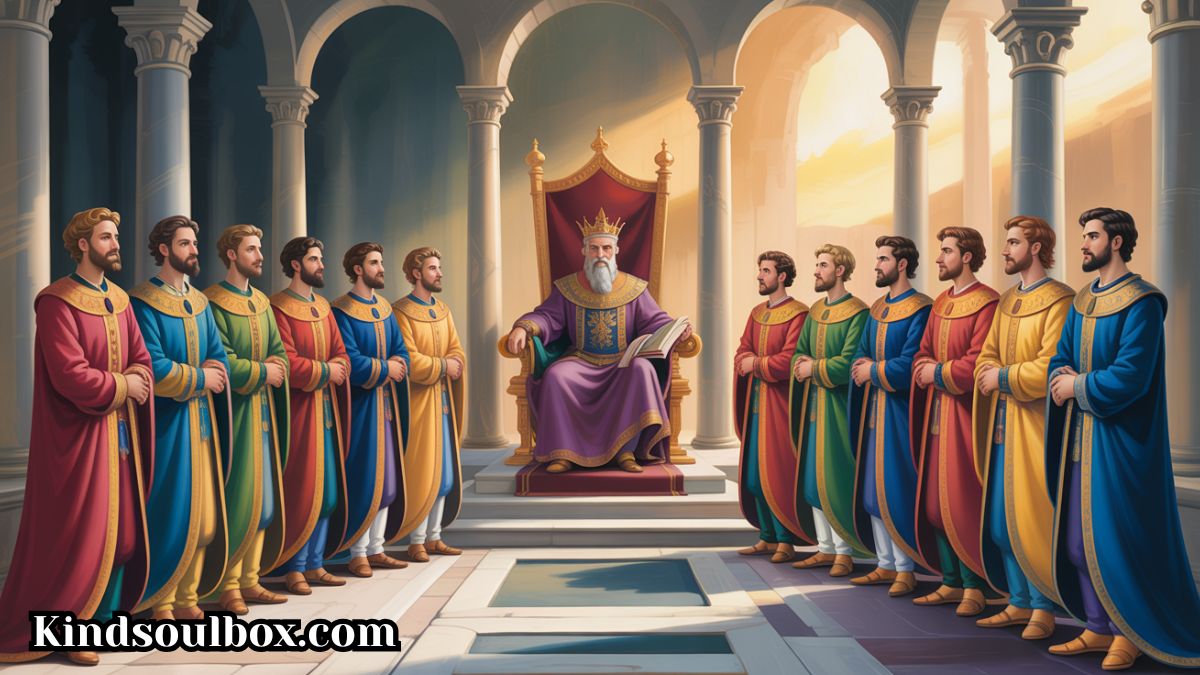
The 12 honorable sons of King Solomon represent a widespread biblical misconception that doesn’t align with scripture. The Bible actually names only one son of Solomon—Rehoboam—though his 1,000 wives likely produced many children. This concept stems from confusion with other biblical numerology and extrabiblical traditions rather than documented genealogy.
Here’s what makes this fascinating: The absence of named sons isn’t a biblical oversight—it’s intentional. Scripture laser-focuses on covenant lineage, tracing only those descendants who advanced God’s redemptive plan. The silence speaks volumes about divine purposes versus human curiosity.
What we discover instead proves far more compelling than any list of twelve names. Through Solomon’s actual documented descendants—kings who reformed Judah, broke generational curses, and ultimately produced Jesus Christ—we witness how God transforms flawed family trees into eternal kingdoms. The real story isn’t about the quantity of sons but the quality of the legacy.
Who Was King Solomon? The Foundation of Understanding
Before we explore King Solomon’s descendants, we need to grasp who this man was.
Solomon rose to power around 970 BCE as Israel’s third monarch. Born to King David and Bathsheba, his very name means “peaceable”—though ironically, his choices would eventually fracture the nation. God also called him Jedidiah, meaning “beloved of the LORD,” marking divine favor from birth.
The biblical genealogy of Solomon places him squarely in the house of David lineage, which matters tremendously. God promised David an eternal kingdom (2 Samuel 7:12-16). Every king in Solomon’s line either honored or betrayed that sacred covenant.
Solomon’s Legendary Wisdom
Solomon’s wisdom became his trademark. When two women claimed the same baby, his brilliant judgment revealed the true mother (1 Kings 3:16-28). This wasn’t just cleverness—God granted him supernatural discernment.
The Queen of Sheba traveled from distant lands just to test his knowledge. She left breathless, declaring that his wisdom exceeded every rumor (1 Kings 10:6-7). Solomon authored 3,000 proverbs and 1,005 songs. Three biblical books bear his mark: Proverbs, Ecclesiastes, and Song of Solomon.
His reputation spread across every nation. Leaders sought audiences. Scholars posed questions. Solomon’s reign over Israel represented wisdom’s golden age.
The Temple That Changed Everything
Solomon spent seven years constructing the Temple of God in Jerusalem. This wasn’t just architecture—it was theology in stone and gold.
The temple housed the Ark of the Covenant in its innermost chamber. When Solomon dedicated it, God’s glory filled the sanctuary so powerfully that priests couldn’t stand (1 Kings 8:10-11). The City of David had finally received its permanent worship center.
This structure stood as tangible proof of God’s presence among His people. Every sacrifice, every prayer, every festival pointed toward divine-human communion.
Wealth Beyond Measure
Solomon’s wealth defied comprehension. Silver became as common as stones in Jerusalem (1 Kings 10:27). His annual gold income reached 666 talents—roughly 25 tons. His throne featured ivory overlaid with gold, flanked by 12 lions on six steps.
He built a fleet of trading ships. foreign goods poured in: apes, peacocks, precious woods. The twelve teams of Israel prospered under his economic policies—at least initially.
But here’s where things got complicated.
The Fatal Flaw: Solomon’s Marriages and Idolatry
Solomon married 700 wives and took 300 concubines (1 Kings 11:3). These weren’t just personal choices—they were political alliances wrapped in romance. Each foreign princess brought trade agreements and military treaties.
They also brought their gods.
Ashtoreth of the Zidonians. Milcom (also called Molech) of the Ammonites. Chemosh of the Moabites. Solomon built high places for these deities on the Mount of Corruption east of Jerusalem.
This violated everything God commanded. Deuteronomy 7:3-4 explicitly warned against marrying pagan women: “They will turn your children away from following me to serve other gods.”
Solomon’s foreign wives did exactly that.
Divine Judgment Pronounced
God’s anger burned against Solomon. The LORD appeared to him twice, yet Solomon still chased idolatry. The verdict came swiftly:
“Since this is your attitude and you have not kept my covenant and my decrees, which I commanded you, I will most certainly tear the kingdom away from you and give it to one of your subordinates. Nevertheless, for the sake of David, your father, I will not do it during your lifetime. I will tear it out of the hand of your son.” (1 Kings 11:11-12)
Divine punishment would strike the next generation. The United Kingdom would shatter. This sets the stage for understanding Rehoboam, son of Solomon, and the crisis he inherited.
Rehoboam: Solomon’s Only Named Son and the Kingdom’s Division
Here’s where we address the “12 sons” question directly: The Bible names only one son of Solomon—Rehoboam.
Born to Naamah the Ammonitess, Rehoboam inherited his father’s throne around 931 BCE. His story appears in both 1 Kings 12 and 2 Chronicles 10-12. What happened next changed Israel forever.
The Catastrophic Decision at Shechem
When Solomon died, the Israelites gathered at Shechem expecting Rehoboam to lighten the crushing tax burden his father had imposed. The northern teams had grown weary. Temple construction and royal luxuries required forced labor and heavy taxation.
Jeroboam, son of Nebat, led their delegation. The people’s request seemed reasonable: “Your father put a heavy yoke on us, but now lighten the harsh labor and the heavy yoke he put on us, and we will serve you” (1 Kings 12:4).
Rehoboam asked for three days to consider. He consulted two groups:
Elder advisors who served Solomon counseled compassion: “If today you will be a servant to these people and serve them and give them a favorable answer, they will always be your servants” (1 Kings 12:7).
Young friends who grew up with him pushed harsh dominance.
Rehoboam chose foolishness. His response dripped with arrogance: “My little finger is thicker than my father’s waist. My father laid on you a heavy yoke; I will make it even heavier. My father scourged you with whips; I will scourge you with scorpions” (1 Kings 12:10-11).
Israel Splits in Two
The ten northern teams rebelled immediately. They crowned Jeroboam king over Israel, establishing Samaria as their capital. Only Judah and Benjamin remained loyal to Rehoboam.
This fulfilled God’s prophecy against Solomon. The division of Israel after Solomon wasn’t a political accident—it was a divine consequence. Disobedience in one generation rippled through the next.
Rehoboam ruled the southern kingdom of Judah for 17 years. He fortified cities and maintained a standing army. But spiritually? He followed Solomon’s worst example, allowing idolatry to flourish. Baalim worship and high places dotted the landscape.
Rehoboam fathered 28 sons and 60 daughters through 18 wives and 60 concubines. Yet scripture names only one son prominently: Abijah, who succeeded him.
Why Doesn’t the Bible Name All Solomon’s Sons?
This question haunts many Bible students. If Solomon had 1,000 women, surely he had dozens—maybe hundreds—of children. Why does scripture mention only Rehoboam?
Biblical Purposes Versus Genealogical Completeness
The Bible isn’t a comprehensive genealogy database. It’s a theological narrative. Scripture focuses on covenant lineage—specifically, the descendants of Solomon kings of Judah who maintained David’s throne.
Sons born to foreign wives likely held no claim to succession. They may have been absorbed into their mothers’ cultures. Perhaps they died young. Scripture doesn’t tell us because they didn’t advance the redemptive storyline.
The “12 Sons” Misconception Examined
The “12 honorable sons” concept appears nowhere in scripture. This likely stems from:
- Confusion with Jacob’s 12 sons (the twelve teams of Israel)
- Extrabiblical traditions and legends
- Wishful pattern-seeking (12 is symbolically significant in scripture)
Some sources conflate Rehoboam’s 28 sons with Solomon’s legacy. Others mix descendants across multiple generations.
Here’s what we know with certainty: Rehoboam is Solomon’s only explicitly named son in the biblical text. Period.
Honorable Descendants: Kings Who Sought the LORD
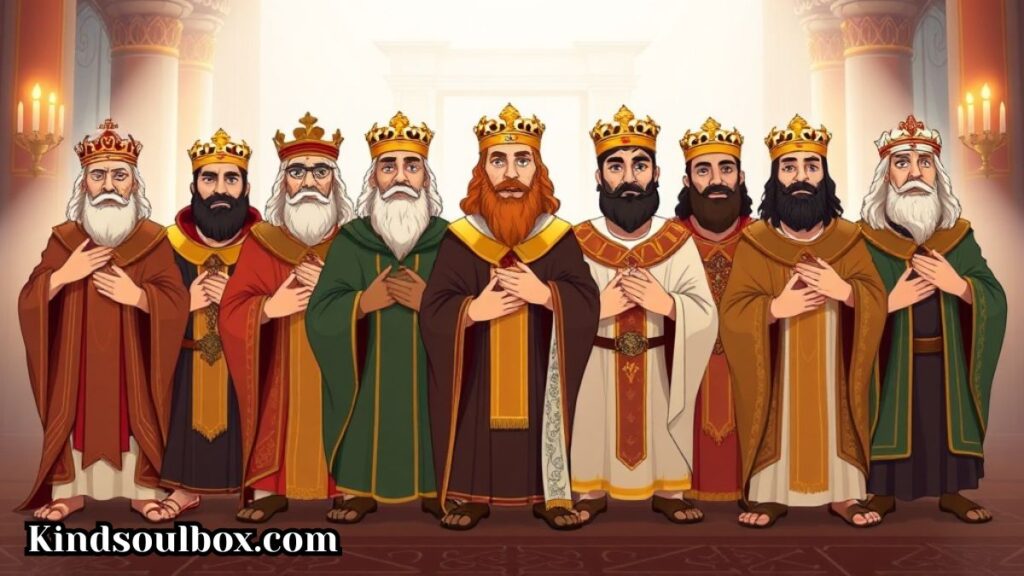
While we can’t list 12 sons, we can trace honorable descendants of Solomon who ruled Judah righteously. These kings proved that faithfulness in leadership could break generational curses.
Asa: The Reformer King
Asa, Rehoboam’s grandson, reigned 41 years (910-869 BCE). 2 Chronicles 14-16 chronicles his transformation of Judah.
He “did what was good and right in the eyes of the LORD his God” (2 Chronicles 14:2). Asa removed foreign altars, smashed sacred stones, and cut down Asherah poles. He even deposed his grandmother, Maakah, for making an obscene idol.
When Ethiopia’s million-man army invaded, Asa cried out to God. Divine blessing brought miraculous victory. He carried back massive plunder.
His reforms spread through Judah, Benjamin, and parts of Ephraim. People flocked to Jerusalem when they saw God favored him.
Jehoshaphat: The Teaching King
Jehoshaphat, Asa’s son, ruled from 872-848 BCE. 2 Chronicles 17 reveals his priorities.
He sent officials and Levites throughout Judah, teaching the Book of the Law. This represented educational reform—making God’s word accessible beyond Jerusalem.
Jehoshaphat strengthened fortresses and stationed troops in conquered cities. Surrounding nations feared attacking. The Philistines brought tribute. Arab delivered 7,700 rams and goats.
He “walked in the ways of his father David” (2 Chronicles 17:3)—note it says David, not Solomon. Jehoshaphat modeled himself after David’s devotion, not Solomon’s compromise.
Joash: The Boy King
Jehoash (also called Joash) became king at seven years old (835-796 BCE). His story appears in 2 Kings 11-12 and 2 Chronicles 22-24.
Queen Athaliah had murdered the entire royal family to seize power. But the priest Jehoiada hid baby Joash in the temple for six years. When he reached seven, Jehoiada orchestrated a coup, executing Athaliah and crowning the rightful heir.
Under Jehoiada’s guidance, Joash “did what was right in the eyes of the LORD” (2 Kings 12:2). He organized funds to repair the crumbling temple. Workers rebuilt worn structures and replaced damaged furnishings.
Tragically, after Jehoiada died, Joash abandoned God and ordered the stoning of Jehoiada’s son Zechariah. His promising reign ended in apostasy.
Uzziah (Azariah): The Prosperous King
Azariah, also called Uzziah, reigned 52 years (792-740 BCE). 2 Chronicles 26 and 2 Kings 15 record his achievements.
He built towers in Jerusalem and fortified defensive positions. He dug cisterns and developed agriculture. His army numbered 307,500 fighting men equipped with shields, spears, bows, and sling stones.
“As long as he sought the LORD, God gave him success” (2 Chronicles 26:5). Uzziah’s fame spread to Egypt’s border.
Pride eventually destroyed him. He attempted to burn incense in the temple—a priestly function forbidden to kings. When priests confronted him, leprosy broke out on his forehead. He lived in isolation until death.
Jotham: The Faithful Builder
Jotham succeeded his leprous father, reigning 16 years (750-735 BCE). 2 Chronicles 27 emphasizes his obedience to God.
He rebuilt the Upper Gate of the temple and constructed extensively on Jerusalem’s walls. He subdued the Ammonites, who paid him 100 talents of silver, 10,000 cors of wheat, and 10,000 cors of barley annually for three years.
Scripture offers this epitaph: “Jotham grew powerful because he walked steadfastly before the LORD his God” (2 Chronicles 27:6). Simple faithfulness brought strength.
Hezekiah: The Reformer Extraordinaire
Hezekiah (715-686 BCE) ranks among Judah’s greatest kings. 2 Kings 18-20 and 2 Chronicles 29-32 detail his comprehensive reforms.
In his first month as king, he reopened and repaired the temple. He destroyed high places, smashed sacred stones, and cut down Asherah poles throughout Judah. He even destroyed the bronze serpent Moses had made because people worshiped it.
Hezekiah celebrated Passover on a scale unseen since Solomon’s era. He invited remnants from northern Israel, and thousands came. The festival was extended an extra seven days due to tremendous joy.
When Assyrian king Sennacherib besieged Jerusalem with 185,000 troops, Hezekiah prayed. God sent an angel who killed the entire Assyrian army overnight. Divine blessing and God’s judgment and mercy intersected dramatically.
Josiah: The Ultimate Reformer
Josiah (640-609 BCE) became king at eight years old. 2 Kings 22-23 chronicles his extraordinary reign.
During temple repairs at age 26, workers discovered the Book of the Law—likely Deuteronomy—lost and forgotten. When it was read to Josiah, he tore his robes in repentance. Judah had violated God’s covenant completely.
Josiah launched the most thorough reform in Judah’s history:
- Destroyed all high places from Geba to Beersheba
- Desecrated pagan altars throughout the land
- Removed mediums, spiritists, and household gods
- Slaughtered pagan priests on their own altars
- Demolished the quarters of male shrine sex workers
- Defiled Topheth in the Valley of Hinnom, where children were sacrificed to Molech
Scripture declares: “Neither before nor after Josiah was there a king like him who turned to the LORD as he did—with all his heart and with all his soul and with all his strength” (2 Kings 23:25).
The Messianic Connection: From Solomon to Jesus Christ
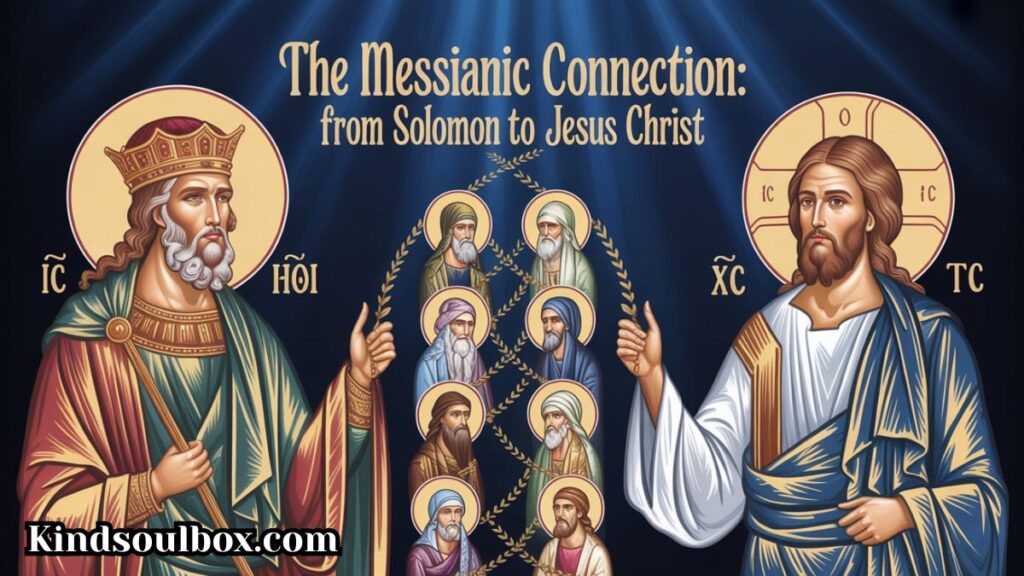
The ultimate “honorable descendant” wasn’t a king of Judah—it was the King of Kings.
Jesus Christ’s lineage through Solomon connects ancient kingship to eternal reign. This matters profoundly for understanding the messianic lineage of Jesus and covenant promises to David.
Matthew’s Genealogy: The Royal Line
Matthew 1:1-17 traces Jesus Christ through Solomon explicitly. The genealogy begins: “A record of the genealogy of Jesus Christ, the son of David, the son of Abraham.”
It flows through Solomon, Rehoboam, Abijah, Asa, Jehoshaphat, and continues through every king of Judah to the Babylonian exile. This establishes Jesus’ legal right to David’s throne.
Matthew includes four women—Tamar, Rahab, Ruth, and Bathsheba (called “Uriah’s wife”). Each had a scandalous background, yet God wove them into messianic history. Grace permeates this lineage.
Luke’s Genealogy: The Bloodline
Luke 3:23-38 traces Jesus through Nathan, another son of David and Bathsheba (1 Chronicles 3:5). Most scholars believe Luke records Mary’s genealogy, showing Jesus’ biological descent.
Both lines converge in David. Jesus holds legal right through Joseph (Solomon’s line) and biological right through Mary (Nathan’s line). He’s David’s heir by every measure.
Jesus: The Greater Solomon
Jesus surpassed Solomon in every category:
| Solomon | Jesus Christ |
|---|---|
| Built a physical temple | “Destroy this temple, and I will raise it again in three days” (John 2:19)—His body was the temple |
| Possessed earthly wisdom | “One greater than Solomon is here” (Matthew 12:42)—wisdom incarnate |
| Ruled Israel temporarily | Rules eternally as King of Kings and Lord of Lords |
| Name means “peaceable” | He IS our peace (Ephesians 2:14) |
| Compromised through foreign alliances | Remained perfectly faithful |
| Kingdom divided | Kingdom will have no end (Luke 1:33) |
Prophecy after prophecy finds fulfillment in Christ:
- Isaiah 9:6-7: “Of the greatness of his government and peace there will be no end. He will reign on David’s throne and over his kingdom.”
- Jeremiah 23:5-6: “I will raise for David a righteous Branch, a King who will reign wisely.”
The covenant God made with David—that his throne would last forever—culminates in Jesus. Not through sinless kings (there were none), but through a sinless King.
Lessons From Solomon’s Descendants for Today
Generational Consequences Are Real
Solomon’s idolatry fractured the kingdom for his son. Rehoboam’s arrogance drove away 10 teams. Sin cascades through time, affecting people we’ll never meet.
But here’s hope: Righteous kings like Asa, Hezekiah, and Josiah broke destructive patterns. They chose obedience to God despite their fathers’ failures. You can too.
God’s Faithfulness Outlasts Human Failure
The house of David’s lineage survived exile, foreign occupation, and national extinction. God preserved it through the Babylonian captivity when Jerusalem burned, and the temple fell.
Why? Because he promised. Covenant promises don’t depend on human perfection—they rest on divine character.
Leadership Requires Listening
Rehoboam ignored wise counsel and listened to arrogant peers. The result? Civil war and permanent national division.
Godly kings in the Bible, like Jehoshaphat, surrounded themselves with teachers and priests. Joash thrived under Jehoiada’s guidance but stumbled when left alone.
Who speaks into your life? Pride whispers that you don’t need advice. Wisdom knows better.
Compromises Compound
Solomon thought political marriages were shrewd diplomacy. They seemed harmless initially. But each foreign wife brought foreign gods. Each altar built led to another.
Small compromises become massive departures. That’s how Israelites who witnessed Red Sea miracles ended up sacrificing children to Molech just generations later.
Repentance Can Redirect Destiny
When Josiah heard God’s word, he tore his clothes and wept. His repentance triggered Judah’s greatest reformation.
Hezekiah faced terminal illness. He prayed. God added 15 years to his life (2 Kings 20:1-6).
It’s never too late to turn back to God. Faithfulness matters more than perfection.
Conclusion
The 12 honorable sons of King Solomon don’t exist in biblical records. Scripture names only Rehoboam as Solomon’s son. This truth matters more than myth. The 12 Honorable Sons of King Solomon. God focused on covenant keepers, not comprehensive genealogies. The 12 Honorable Sons of King Solomon. The honorable descendants who followed—Asa, Jehoshaphat, Hezekiah, Josiah—proved faithfulness breaks generational sin.
Searching for the 12 honorable sons of King Solomon leads somewhere better: Jesus Christ. Through Solomon’s flawed lineage came the perfect King. The 12 Honorable Sons of King Solomon. God kept His promises despite human failure. That’s the real legacy. Not twelve sons, but one Savior who reigns forever. His kingdom never ends.
FAQs
Did King Solomon really have 12 honorable sons in the Bible?
No. The Bible names only one son of Solomon—Rehoboam. The “12 sons” concept has no scriptural basis and likely stems from confusion with other biblical patterns.
How many children did Solomon actually father?
Scripture doesn’t provide an exact count. With 700 wives and 300 concubines, Solomon likely had many children, but only Rehoboam is explicitly named as his son.
Which descendants of Solomon were righteous kings?
Asa, Jehoshaphat, Joash, Uzziah, Jotham, Hezekiah, and Josiah stand out. These kings led religious reforms in Judah and sought to obey God faithfully during their reigns.
Is Jesus Christ descended from King Solomon?
Yes. Matthew’s genealogy traces Jesus through Solomon’s royal line, establishing His legal right to David’s throne as the promised Messiah.
Why doesn’t the Bible list all of Solomon’s sons?
Scripture focuses on covenant lineage—those who inherited Judah’s throne and advanced God’s redemptive plan. Sons from foreign wives held no succession claims and weren’t theologically relevant.