The term pumpkin bible verse refers to Scripture passages Christians pair with pumpkins during fall to teach spiritual truths. While the Bible never mentions pumpkins directly, this harvest fruit has become a powerful teaching tool connecting carving stages with biblical themes of transformation and light.
A plain orange pumpkin becomes a glowing beacon pushing back darkness—that’s the gospel in autumn’s most recognizable symbol. God takes ordinary vessels, cleans out what’s broken, and fills them with His light.
Churches nationwide use Christian pumpkin symbolism for effective faith-sharing during harvest season. From Sunday school lessons to outreach events, pumpkins spark conversations about spiritual transformation that engage audiences of all ages.
The Truth About “Pumpkin Bible Verses”
Here’s the honest answer: you won’t find pumpkins mentioned anywhere in the Bible. That’s because pumpkins are native to North America, and Scripture was written in the Middle East thousands of years before European explorers even knew the Americas existed.
So why do so many people search for pumpkin bible verse content?
Because Christians have discovered something beautiful—the pumpkin serves as an incredible teaching tool that connects autumn traditions with eternal spiritual truths. This practice is called the Pumpkin Parable or Pumpkin Gospel, and it’s become a beloved tradition in churches across the country.
The tradition started gaining momentum in the 1990s when children’s ministry leaders looked for ways to offer faith-based alternatives during Halloween season. They realized that carving pumpkins—already a popular fall activity—could become a hands-on gospel presentation that kids would never forget.
The biblical symbolism of pumpkins isn’t forced or artificial. It follows the same teaching method that God used throughout Scripture. Jesus constantly used agricultural examples—seeds, vines, wheat, fig trees—to illustrate spiritual transformation and kingdom principles. Romans 1:20 tells us that God’s creation reveals His invisible qualities, making them understood through what has been made.
When we use a pumpkin to teach about faith, we’re following a thoroughly biblical pattern of learning spiritual lessons from nature.
The Complete Pumpkin Gospel Story with Scripture References
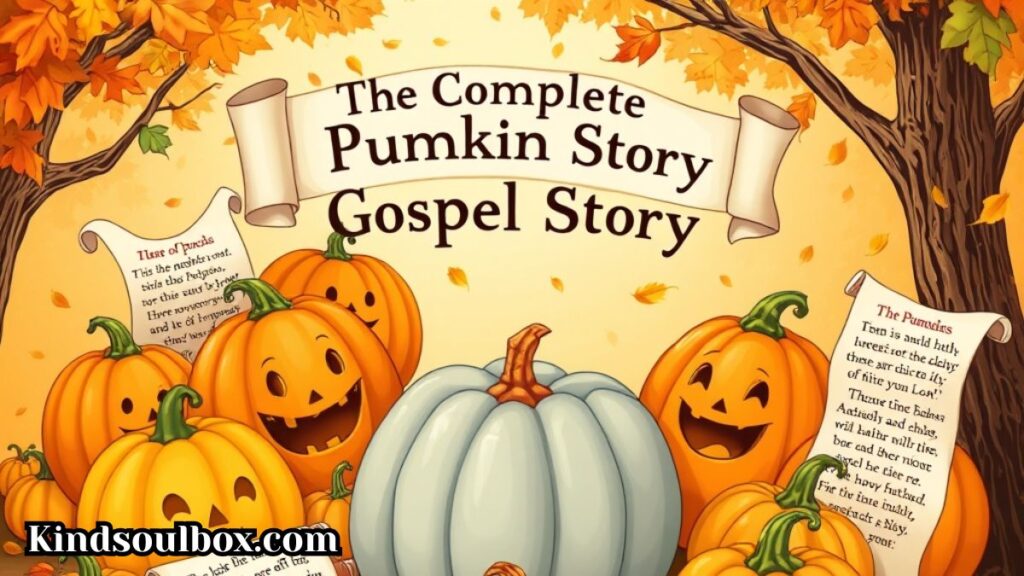
The Pumpkin Gospel unfolds in four distinct stages, each one paired with powerful Scripture that brings the lesson to life. This presentation works beautifully for Christian fall activities, children’s messages, and even evangelistic outreach events.
God Picks You (Creation)
Every pumpkin starts in a patch among dozens or hundreds of others. The farmer walks through the field and selects specific pumpkins for a special purpose. Some get chosen for pies. Others become decorations. The best ones? They become jack-o’-lanterns that will shine with light.
This mirrors how God chose you before you were even born.
Ephesians 1:4 declares, “He chose us in him before the foundation of the world, that we should be holy and blameless before him.” You weren’t an accident or an afterthought. God looked across all of humanity and picked you specifically for His purposes.
Jeremiah 1:5 reinforces this beautiful truth: “Before I formed you in the womb I knew you, and before you were born I consecrated you.” Just like that farmer selecting a pumpkin, God selected you with intentionality and love. He saw your potential before anyone else did—including yourself.
The spiritual meaning of pumpkins begins here, with the reminder that your life has divine purpose. You weren’t randomly placed on this earth. You were chosen.
Cleaning Out the Inside (Confession & Repentance)
Anyone who’s carved a pumpkin knows this is the messiest part. You cut open the top and discover all that slimy pulp and stringy guts inside. Everything has to come out—the seeds, the fiber, all of it—before the pumpkin can fulfill its purpose.
This represents the cleansing work of confession and repentance in our lives.
Psalm 51:10 captures this perfectly: “Create in me a clean heart, O God, and renew a right spirit within me.” David wrote these words after his sin with Bathsheba, recognizing that he needed God to clean out the messy interior of his heart.
1 John 1:9 promises, “If we confess our sins, he is faithful and just to forgive us our sins and to cleanse us from all unrighteousness.” The spiritual transformation begins when we let God scoop out the sin, guilt, shame, and brokenness that’s been hiding inside us.
Here’s what makes this part of the pumpkin parable so powerful for kids: they can see and feel the yucky stuff coming out. It’s tangible. They understand immediately that sin isn’t something we want to keep inside. Just like that gross pumpkin guts, sin needs to go.
The transformation God wants to work in you requires removing what doesn’t belong. It might feel uncomfortable—even painful—but it’s absolutely necessary.
Carving a New Face (Transformation)
Once the inside is clean, the real artistry begins. The carver takes a knife and carefully cuts a new face into the pumpkin. What was once just a plain orange sphere now has personality, expression, and character. Most people carve smiles because jack-o’-lanterns are supposed to look happy and welcoming.
This symbolizes the new identity we receive in Christ.
2 Corinthians 5:17 proclaims one of the most powerful truths in all of Christianity: “Therefore, if anyone is in Christ, he is a new creation. The old has passed away; behold, the new has come.” You’re not just cleaned up—you’re completely recreated.
Romans 12:2 (one of the key verses in biblical teachings about change) instructs us: “Do not be conformed to this world, but be transformed by the renewal of the mind, so that by testing you may discern what is the will of God, what is good and acceptable and perfect.” The Greek word for “transformed” is metamorphoō—the same root we get “metamorphosis” from. Think of a caterpillar becoming a butterfly. That’s the level of change God wants to work in you.
The carved smile on a pumpkin reminds us that spiritual transformation should be visible. When Jesus Christ changes your heart, people should see the difference in your countenance, your words, your actions. Joy becomes your default expression because you’ve been given a new face—a new identity in Christ.
Placing the Light Inside (Holy Spirit)
The final step transforms the pumpkin from a carved decoration into something truly special. When you place a candle or light inside, everything changes. The carved features begin to glow. Darkness around it gets pushed back. That pumpkin becomes a beacon that can be seen from a distance, especially on a dark night.
This represents the Holy Spirit living inside believers.
Matthew 5:14-16 contains perhaps the most famous light of the world scripture: “You are the light of the world. A city set on a hill cannot be hidden. Nor do people light a lamp and put it under a basket, but on a stand, and it gives light to all in the house. In the same way, let your light shine before others, so that they may see your good works and give glory to your Father who is in heaven.”
John 8:12 records Jesus saying, “I am the light of the world. Whoever follows me will not walk in darkness, but will have the light of life.” When Christ lives in you through His Spirit, His light shines through you.
Ephesians 5:8 reminds believers, “At one time you were darkness, but now you are light in the Lord. Walk as children of light.” The light within a pumpkin is a perfect picture of this truth. The pumpkin doesn’t generate its own light—it simply allows the light placed inside it to shine through.
You don’t manufacture spiritual light through good deeds or positive thinking. The light is Jesus Christ himself, dwelling in you through the Holy Spirit. Your job? Let His light shine through the unique design He’s carved into your life.
Ten Best Bible Verses to Use with Pumpkin Activities
When you’re planning Christian autumn symbolism lessons, harvest season devotions, or faith-based pumpkin craft ideas, these verses create powerful connections:
1. Matthew 5:16 – “Let your light shine before others” This is the most popular choice for pumpkin and Christianity lessons. It directly connects to the glowing jack-o’-lantern and makes an unforgettable impression on children.
2. Psalm 139:13-14 – “I am fearfully and wonderfully made” Perfect for teaching kids that God designed each person uniquely, just like every carved pumpkin looks different.
3. 2 Corinthians 5:17 – “New creation in Christ” Excellent for illustrating how spiritual transformation completely changes us from the inside out.
4. Philippians 4:13 – “I can do all things through him who strengthens me” Reminds us that the spiritual growth we experience comes from Christ’s power within us, not our own effort.
5. Proverbs 3:5-6 – “Trust in the Lord with all your heart” A great verse for discussing how God guides and directs our lives with purpose, just like a farmer carefully tends pumpkins.
6. John 3:16 – “For God so loved the world” The foundation of the gospel message, easily incorporated into any Christian pumpkin symbolism presentation.
7. Galatians 5:22-23 – “The fruit of the Spirit” Creates a fun wordplay opportunity since pumpkins are technically fruits, and believers should produce spiritual fruit as spiritual metaphor for character.
8. 1 Thessalonians 5:16-18 – “Rejoice always, pray without ceasing, give thanks” Perfect for Thanksgiving season pumpkin devotions focused on gratitude.
9. Colossians 3:23 – “Work heartily, as for the Lord” Excellent for teaching kids to approach even simple tasks like pumpkin carving with excellence to honor God.
10. Romans 8:28 – “All things work together for good” Reminds us that God’s provision and plan are always at work, even in ordinary autumn traditions.
How to Use Pumpkin Bible Verses: Practical Applications
The biblical symbolism of pumpkins isn’t just theoretical—it’s meant to be experienced and shared. Here are proven ways to incorporate these lessons into your ministry, family, and community outreach.
For Sunday School & Children’s Ministry
Pumpkin carving demonstrations create unforgettable object lessons. Set up a carving station where kids can watch each step while you explain the corresponding Scripture. The visual, kinesthetic experience helps them remember the gospel message long after the lesson ends.
Create printable verse cards that attach to small decorative pumpkins. Kids can take these home as reminders of what they learned. Include both the pumpkin bible verse and a simple explanation of how it connects to the pumpkin stages.
Age-appropriate devotional lessons work for different groups:
- Preschool (3-5): Focus on God choosing them and putting His light inside them
- Elementary (6-11): Walk through all four stages with more detailed Scripture
- Tweens (12-14): Discuss deeper spiritual transformation themes and personal application
For Fall Festivals & Trunk-or-Treat Events
Alternative to secular Halloween messaging doesn’t mean being anti-fun. It means offering something even better—a message of hope wrapped in a familiar autumn tradition. The Pumpkin Gospel gives families a positive, faith-centered option.
Evangelism tool for community outreach works because it’s non-threatening. Neighbors who might decline a church invitation will happily accept a carved pumpkin with a Scripture card attached. That pumpkin sits on their porch for weeks, sharing the light of the world scripture with everyone who passes by.
Hand out Scripture cards with candy during trunk-or-treat events. Kids love the candy, but parents appreciate the faith-based message. Many churches report that these cards spark spiritual conversations with families who don’t regularly attend church.
For Family Devotions
A step-by-step pumpkin carving devotional turns a fun activity into a powerful teaching moment. Gather your family around the kitchen table with a pumpkin, carving tools, and your Bible.
Discussion questions for each carving stage:
- When selecting the pumpkin: “How does it feel to know God chose you specifically?”
- While scooping out seeds: “What ‘yucky stuff’ do we need to ask God to clean out of our hearts?”
- During the carving: “What new things has God been creating in your life lately?”
- After lighting the candle: “How can your light shine brighter for Jesus at school/work this week?”
Memory verse activities make learning Scripture fun. Write Matthew 5:14-16 on orange paper cut into pumpkin shapes. Kids can decorate them and place them where they’ll see them daily.
For Social Media & Church Marketing
Graphics pairing pumpkin photos with verses perform exceptionally well during autumn months. Create quote images featuring carved pumpkins glowing at twilight with verses like Matthew 5:14-16 overlaid in attractive fonts.
Caption ideas for Instagram/Facebook posts:
- “Every pumpkin starts ordinary. But when God’s light shines through, it becomes extraordinary. #PumpkinGospel”
- “What’s inside makes all the difference. Let Christ’s light shine through you today. #FaithAndFall”
- “From patch to porch—a story of transformation. Just like our journey with Jesus. #ChristianAutumn”
Hashtag suggestions help your content reach people searching for faith-based fall activities: #PumpkinGospel, #FaithAndFall, #ChristianPumpkin, #LightOfTheWorld, #FallFaith, #HarvestLessons, #PumpkinParable, #ChristianAutumn
The Theological Foundation: Biblical Symbols in Nature
Using a pumpkin to teach spiritual truths isn’t a modern gimmick—it’s rooted in solid biblical precedent. Jesus Christ constantly drew lessons from agriculture and nature. He wasn’t just being poetic; He was following the teaching method His Father built into creation itself.
Consider Jesus’ parables:
- The Parable of the Sower (Matthew 13:1-23)
- The Parable of the Wheat and Tares (Matthew 13:24-30)
- The Parable of the Mustard Seed (Matthew 13:31-32)
- The Parable of the Fig Tree (Luke 13:6-9)
- The Vine and the Branches (John 15:1-8)
Romans 1:20 explains why this works: “For his invisible attributes, namely, his eternal power and divine nature, have been clearly perceived, ever since the creation of the world, in the things that have been made.” God’s creation is designed to teach us about Him.
Psalm 19:1 declares, “The heavens declare the glory of God, and the sky above proclaims his handiwork.” Creation isn’t silent—it’s constantly testifying to God’s character, power, and purposes.
The harvest season appears throughout Scripture as a time of abundance, celebration, and thanksgiving. Deuteronomy 16:15 describes the Feast of Tabernacles (a harvest festival): “For the Lord your God will bless you in all your produce and in all the work of your hands, so that you will be altogether joyful.”
When we use pumpkins—a prominent harvest crop—to illustrate biblical teachings, we’re tapping into this rich agricultural imagery that runs throughout Scripture. We’re not adding to the Bible; we’re using creation exactly as God intended—as a teacher that points people toward eternal truth.
The balance we must maintain: The Pumpkin Parable is a teaching illustration, not Scripture itself. It’s a tool, not doctrine. We should never elevate the object lesson above the actual Word of God. But when used properly, it becomes a memorable bridge that helps people—especially children—grasp profound theological concepts they might otherwise struggle to understand.
Deeper Spiritual Lessons from Pumpkin Symbolism
Beyond the basic Pumpkin Gospel presentation, several other biblical themes emerge from this humble autumn fruit.
Transformation and Growth
A pumpkin seed doesn’t look anything like the massive fruit it becomes. Plant that tiny seed in spring, and by fall you’ll harvest a pumpkin that weighs 10, 20, even 100+ pounds. That’s extraordinary growth from such a small beginning.
Mark 4:26-29 describes the kingdom of God this way: “The kingdom of God is as if a man should scatter seed on the ground. He sleeps and rises night and day, and the seed sprouts and grows; he knows not how.” Spiritual growth often happens in ways we can’t fully see or understand, but it’s real and ongoing.
Romans 12:2 emphasizes the renewal of the mind as central to transformation. The Greek word anakainōsis (renewal) suggests a continual, progressive renovation—not a one-time event. Just as a pumpkin grows gradually over months, your spiritual maturity develops through consistent exposure to Scripture, prayer, and the work of the Holy Spirit.
The hard shell / nourishing interior of a pumpkin teaches another lesson about appearances versus reality. From the outside, a pumpkin looks tough and impenetrable. But inside? Soft, useful, nourishing flesh and seeds full of potential.
1 Samuel 16:7 warns, “The Lord sees not as man sees: man looks on the outward appearance, but the Lord looks on the heart.” God isn’t interested in your exterior presentation—He’s developing the interior reality of your character.
Abundance and Thanksgiving
A single pumpkin vine can produce multiple large pumpkins. Cut open one pumpkin and you’ll find hundreds of seeds—each one capable of producing multiple pumpkins the next season. That’s exponential abundance.
Philippians 4:19 promises, “And my God will supply every need of yours according to his riches in glory in Christ Jesus.” This isn’t describing bare-minimum provision—it’s describing the lavish, overflowing abundance that characterizes God’s provision.
The harvest season has always been a time for expressing gratitude. When the growing season ends successfully and barns are full, ancient Israelites celebrated with thanksgiving offerings and festivals. Modern Thanksgiving traditions continue this heritage.
1 Thessalonians 5:18 instructs, “Give thanks in all circumstances; for this is the will of God in Christ Jesus for you.” The pumpkin serves as a tangible reminder to cultivate gratitude for the countless ways God provides for us daily.
Gratitude-themed gatherings during autumn create natural opportunities to reflect on God’s abundance. Whether it’s a church Thanksgiving service or a family meal, incorporating pumpkin spiritual analogy helps people connect everyday blessings to their source—a generous, loving Father.
Light and Witness
A jack-o’-lantern serves only one real purpose: to shine light in darkness. That’s it. A carved pumpkin with no light inside is just decoration. But add that candle or bulb, and suddenly it fulfills its purpose—pushing back darkness and creating beauty in the night.
Matthew 5:14-16 isn’t a suggestion—it’s an identity statement. Jesus didn’t say “try to be light” or “you should become light.” He said, “You ARE the light of the world.” Illumination is the natural state of a believer filled with the Holy Spirit.
The question isn’t whether you’re supposed to shine. The question is whether anything is blocking the light from coming through. Just as a dirty pumpkin exterior dims the glow, sin and compromise in our lives can obscure the witness we’re meant to give.
Ephesians 5:8-9 expands on this: “At one time you were darkness, but now you are light in the Lord. Walk as children of light (for the fruit of light is found in all that is good and right and true).” Notice that phrase—”fruit of light.” Being a light produces visible results, just like a glowing jack-o’-lantern produces visible brightness.
Light Workshops and lantern-making events give churches creative ways to explore this theme. Participants create their own decorated luminaries while discussing how they can be beacons of light in their schools, workplaces, and neighborhoods.
Practical Pumpkin Ministry Ideas
The Christian pumpkin symbolism becomes most powerful when it moves from theory to practice. Here are field-tested ideas that churches and families have used successfully:
Pumpkin Patch Outreach Events
Partner with a local pumpkin farm or create a patch at your church. Families visit, select pumpkins, and receive a card explaining the Pumpkin Gospel along with carving instructions and relevant Bible verses. This low-pressure approach introduces church to families who might not otherwise attend.
Pumpkin Carving Nights
Host these as alternative Christian fall activities to Halloween parties. Provide pumpkins, carving tools, and safety equipment. Station volunteers at different tables to share each stage of the Pumpkin Parable as families work on their projects. End with lighting all the jack-o’-lanterns together while reading Matthew 5:14-16.
Pumpkin Seed Giveaways
After carving demonstration events, clean and roast pumpkin seeds. Package them in small bags with faith lessons from pumpkins printed on the label. Each seed represents potential for future growth—both for plants and for spiritual transformation when people respond to the gospel.
Senior Ministry Applications
Don’t assume pumpkin lessons are only for kids. older people enjoy autumn crafts too. Provide small decorative pumpkins for painting (safer than carving), along with Scripture cards. This creates intergenerational opportunities when older people and children work together on projects.
Missions and Outreach Opportunities
The Pumpkin Gospel translates across cultures remarkably well, especially in agricultural communities worldwide. Missionaries report using local harvest fruits (gourds, squash, etc.) to share the same four-stage message with powerful results.
Addressing Common Questions About Pumpkin Bible Verses
Is the pumpkin gospel biblically accurate?
Yes and no. The pumpkin itself isn’t in Scripture, but the spiritual principles it illustrates absolutely are. The four stages—selection, cleansing, transformation, and illumination—are all thoroughly biblical concepts supported by clear Scriptural teaching.
Think of it like this: Jesus never mentioned automobiles, yet we can truthfully say “Jesus is in the driver’s seat of my life.” We’re using a modern object to communicate an ancient truth. That’s exactly what the Pumpkin Parable does.
The danger comes if someone treats the object lesson as equal to Scripture itself or adds meaning that doesn’t align with biblical teachings. As long as we keep the illustration connected to actual Bible verses and sound theology, it’s a legitimate teaching tool.
Can I use this for evangelism?
Absolutely. The Pumpkin Gospel has proven to be an effective evangelistic tool because it’s:
- Visual and memorable: People remember stories and objects better than abstract concepts
- Non-threatening: It doesn’t feel like a confrontational “altar call”
- Age-appropriate: Works equally well for children and adults
- Culturally accessible: Everyone recognizes pumpkins and carving traditions
Best practices for evangelistic use:
- Let the Scripture speak for itself—don’t over-explain
- Focus on the gospel essentials: sin, grace, transformation, and new life
- Provide clear next steps for people interested in learning more
- Follow up with interested individuals personally, not just through printed materials
- Always point to Jesus Christ as the central figure, not the pumpkin
What about Halloween concerns?
This is where Christian families often divide. Some avoid anything Halloween-related entirely. Others participate fully without concern. The majority land somewhere in the middle, looking for ways to engage with autumn traditions while maintaining faith values.
The biblical symbolism of pumpkins offers a third way. You don’t have to boycott fall activities or compromise your convictions. Instead, you redeem cultural symbols by infusing them with gospel meaning.
Romans 14:5-6 provides wisdom here: “One person esteems one day as better than another, while another esteems all days alike. Each one should be fully convinced in his own mind. The one who observes the day, observes it in honor of the Lord.”
If your conscience allows you to use pumpkins and autumn imagery without feeling you’re compromising, then do so to the glory of God. If you feel convicted against it, honor that conviction. But don’t judge others whose convictions differ from yours on disputable matters.
The pumpkin itself is neutral—just a fruit. What matters is the message you attach to it and the heart behind your participation in autumn activities.
Downloadable Resources for Your Pumpkin Ministry
To maximize the impact of your pumpkin and Christianity lessons, quality resources make all the difference. Here’s what you should create or obtain:
Free Printable “Pumpkin Prayer” Cards – These wallet-sized cards contain the four stages of the Pumpkin Gospel on one side and a salvation prayer on the other. Hand them out at fall festivals, trunk-or-treat events, or include them with gift pumpkins.
Pumpkin Gospel Tract Templates – Design these to look like seed packets. The front features an attractive pumpkin image. Inside, the four stages are explained with corresponding Scripture references. The back includes contact information for your church and an invitation to visit.
Coloring Pages with Verses for Kids – Create simple line drawings of pumpkins at various stages (whole, carved, glowing) with Bible verses written below. Children color them while adults explain the spiritual meaning of pumpkins. These work perfectly for Sunday school, Vacation Bible School autumn themes, or family devotions.
Step-by-Step Carving Guide with Scriptures – This detailed handout walks families through carving their pumpkin at home while conducting their own devotional. Each step includes the pumpkin bible verse, discussion questions, and practical carving tips.
Five-Day Pumpkin Devotional for Families – Spread the lesson across multiple days for deeper impact:
- Day 1: God Chooses Us (Ephesians 1:4, Jeremiah 1:5)
- Day 2: Cleansing from Sin (Psalm 51:10, 1 John 1:9)
- Day 3: New Creation (2 Corinthians 5:17, Romans 12:2)
- Day 4: Filled with Light (Matthew 5:14-16, John 8:12)
- Day 5: Sharing Your Light (Ephesians 5:8, 1 Peter 2:9)
Conclusion
The pumpkin bible verse tradition reminds us that God uses simple things to teach profound truths. Pumpkin Bible Verse. Every carved pumpkin glowing in the darkness points to the transformative power of Christ’s light within believers. Pumpkin Bible Verse. This autumn symbol isn’t just decoration—it’s a gospel message waiting to be shared with your family, church, and community.Pumpkin Bible Verse.
Let the pumpkin bible verse lessons inspire you this fall season. Pumpkin Bible Verse. Carve your pumpkin with purpose. Pumpkin Bible Verse. Light it with intention. Pumpkin Bible Verse. Share the Scripture that transforms ordinary harvest fruit into extraordinary teaching moments. Pumpkin Bible Verse. Most importantly, let your own light shine brightly for Jesus, just like that glowing jack-o’-lantern on a dark October night.
FAQs
Is there an actual pumpkin mentioned in the Bible?
No, Scripture doesn’t mention pumpkins since they’re native to the Americas. Writers composed the Bible in the Middle East before anyone there knew pumpkins existed.
What is the Pumpkin Gospel message?
It’s a four-stage teaching tool that uses pumpkin carving to illustrate salvation: God picks you, cleans out sin, carves a new identity, and fills you with His light so you can shine for others.
What Bible verse goes best with carved pumpkins?
Matthew 5:14-16 about being “the light of the world” works as the most popular choice. It perfectly connects to the glowing jack-o’-lantern that shares light in darkness.
Can I use pumpkin lessons for church outreach events?
Yes, churches use the pumpkin bible verse method excellently for fall festivals, trunk-or-treat events, and community outreach. It offers a non-threatening and memorable approach for all ages.
Are pumpkin gospel lessons only for children?
No, these lessons engage all ages effectively. Kids love the hands-on carving experience, while adults appreciate the depth of transformation, cleansing, and witness themes that Scripture presents.on carving, adults appreciate the depth of transformation, cleansing, and witness themes from Scripture.