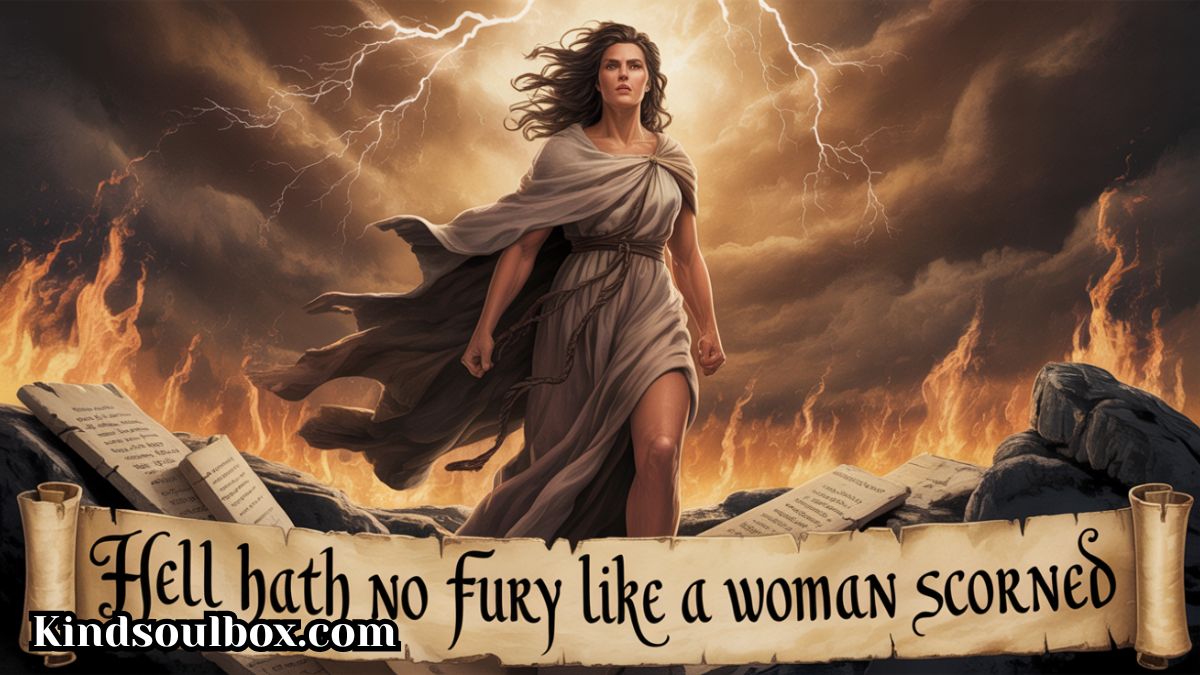
“Hell hath no fury like a woman scorned” stands as one of history’s most quoted phrases—yet it never appears in Scripture. This misattribution to the Bible has fooled millions who search for the hell hath no fury like a woman scorned Bible verse, believing God’s Word warns specifically about rejected women’s rage.
Here’s the plot twist that’ll blow your mind: a 17th-century English playwright named William Congreve penned this line in “The Mourning Bride” (1697), not Moses, David, or any biblical prophet. Somehow, three centuries of cultural propagation transformed theatrical dialogue into supposed divine wisdom.
The phrase captures something primal about betrayal and vengeance that resonates across generations. While the Bible absolutely discusses love to hatred turned through powerful narratives featuring Jezebel, Delilah, and other complex women, Scripture’s actual message contradicts the celebration of fury. Understanding this distinction reveals fascinating truths about biblical narratives, gender dynamics, and how common misconceptions shape what we think the Bible teaches.
The Real Origins: William Congreve and The Mourning Bride
Let’s set the record straight immediately.
William Congreve, an English playwright, penned the actual line in 1697. His tragedy “The Mourning Bride” contains this exact passage:
“Heav’n has no rage like love to hatred turned, Nor Hell a fury, like a woman scorned.”
Notice the difference? The original is more poetic and nuanced. Over three centuries, the phrase underwent linguistic evolution, morphing into the snappier version we know today. People shortened it, punched it up, and somehow convinced themselves it belonged in Scripture.
The Mourning Bride tells the story of Almeria, who believes her husband Alphonso has died. When she discovers he’s alive but faces execution, she experiences intense emotional turmoil. Congreve’s line captures the transformative power of betrayal—how trusted love can mutate into something terrifying when violated.
The play itself has faded into obscurity. Most literature students couldn’t summarize its plot. Yet this single line achieved immortality, outliving every other word Congreve wrote.
Why Everyone Thinks It’s Biblical: The Great Misattribution

Here’s where things get interesting.
The King James Bible, published in 1611, shaped English literature more profoundly than any other text. Its poetic cadence and memorable phrasing seeped into everyday language. Hundreds of idioms we use casually originated in Scripture—or so we think.
Consider these common misconceptions:
- “God helps those who help themselves” (Actually Ben Franklin)
- “Cleanliness is next to godliness” (John Wesley sermon)
- “Money is the root of all evil” (Misquote—it’s the love of money, per 1 Timothy 6:10)
- “This too shall pass” (Persian adage, not biblical)
Cognitive bias plays a massive role here. The phrase sounds biblical. It has that Old Testament thunder. It echoes the moral warnings we associate with Scripture. Our brains fill in the gaps, creating false memories of reading it in Proverbs or hearing it quoted in church.
The phrase’s structure mirrors biblical parallelism—the literary device where similar ideas get expressed in successive lines. “Heaven” and “Hell” create symmetry. The language feels ancient and authoritative.
Plus, as we’ll see, the Bible does contain stories and verses about difficult women and vindictiveness. So the misattribution to the Bible seems logical. People assume there must be a specific verse somewhere that says exactly this.
There isn’t.
What Scripture Actually Says About Contentious Women

While you won’t find our famous phrase in the Bible, you’ll discover plenty about challenging relationships and quarrelsome dynamics.
Proverbs Pulls No Punches
Proverbs 21:9 states: “Better to live on a corner of the roof than share a house with a quarrelsome wife.”
Proverbs 21:19 doubles down: “Better to live in a desert than with a quarrelsome and nagging wife.”
Proverbs 27:15-16 compares a contentious woman to “a constant dripping on a rainy day” and says restraining her is like “restraining the wind or grasping oil with the hand.”
These verses don’t celebrate female rage. They warn against it. They counsel men to recognize toxic relationship patterns and protect their peace—even if it means literal isolation.
Context Matters
Before anyone gets offended, remember these proverbs emerged from an ancient patriarchal society. The same book contains wisdom about foolish men, wicked rulers, and lazy people. Proverbs uses hyperbole and humor to make memorable points about human nature.
The biblical view of emotional betrayal isn’t gendered exclusively. Scripture condemns uncontrolled anger in everyone:
- Ephesians 4:26-27: “Be angry but do not sin; do not let the sun go down on your anger.”
- James 1:19-20: “Everyone should be quick to listen, slow to speak and slow to become angry, because human anger does not produce the righteousness that God desires.”
- Colossians 3:8: “But now you must also rid yourselves of all such things as these: anger, rage, malice, slander, and filthy language from your lips.”
Gender roles in biblical times created specific dynamics, but the underlying principles about controlling wrath apply universally.
Biblical Women Who Embodied Fury and Revenge
Scripture doesn’t shy away from depicting powerful women in the Bible who sought revenge. These biblical narratives provide the raw material that makes people think the “woman scorned” phrase belongs in the Bible.
Jezebel: The Name That Became an Insult
When someone calls a woman “Jezebel” today, it’s not a compliment. This Phoenician princess married King Ahab and became the ultimate biblical villainess.
1 Kings 16:31 introduces her as Ahab’s wife who led him into Baal worship. But her true colors shine in the Naboth incident.
Naboth owned a vineyard Ahab wanted. When Naboth refused to sell his ancestral land, Ahab sulked like a toddler. Jezebel took charge with chilling efficiency. She orchestrated a sham trial, arranged false witnesses, and had Naboth stoned to death. Then she gifted the vineyard to her husband.
The prophet Elijah confronted Ahab with God’s judgment. Years later, when Jezebel’s downfall came, it was spectacular. As prophesied, dogs ate her body, leaving only her skull, feet, and palms (2 Kings 9:30-37).
Jezebel wasn’t scorned romantically—she was politically and religiously opposed. Her rage stemmed from power dynamics and religious conflict. She represents manipulation, false testimony, and murderous vindictiveness in pursuit of goals.
Delilah: Was She Really Scorned?
The Delilah and Samson betrayal story is legendary. Everyone knows she cut his hair and destroyed his strength.
But was Delilah actually a scorned woman seeking revenge?
Not according to Judges 16. The Philistine rulers approached her with a business proposition: “See if you can lure him into showing you the secret of his great strength and how we can overpower him… Each one of us will give you eleven hundred shekels of silver.”
That’s 5,500 shekels total—a fortune.
Delilah’s motivation was financial, not emotional. She persistently nagged Samson until he revealed his Nazirite secret. Then she collected her payment while Samson got captured, blinded, and enslaved.
The scorned woman archetype doesn’t fit Delilah. She’s a mercenary, not a jilted lover. The biblical stories about betrayal involving her teach lessons about temptation, weakness, and the consequences of revealing secrets to untrustworthy people.
Herodias: A Grudge Served on a Platter
Herodias holds a grudge that ends with John the Baptist’s head as party entertainment.
Here’s the setup: Herodias was originally married to Philip (Herod Antipas’s brother). Herod Antipas divorced his wife to marry Herodias—a scandalous move. John the Baptist publicly condemned this illegal marriage, saying Herod had no right to his brother’s wife (Mark 6:17-18).
Herodias nursed her rage. She wanted John dead but couldn’t execute him because Herod feared John’s prophetic status.
Then came the birthday party. Herodias’s daughter danced so beautifully that Herod rashly promised her anything she wanted. Coached by her mother, the girl requested John’s head on a platter.
Herod reluctantly complied (Mark 6:21-28).
This wasn’t romantic rejection—it was emotional indignation over public criticism. Herodias couldn’t tolerate John’s moral rebuke, so she engineered his murder through manipulation.
Potiphar’s Wife: False Accusations as Weaponized Fury
Genesis 39 tells the story of Joseph and his master Potiphar’s wife. She repeatedly propositioned Joseph, who consistently refused because sleeping with his master’s wife would betray trust and sin against God.
One day, she grabbed his cloak. Joseph fled, leaving the garment behind. Scorned and humiliated, she weaponized false accusations.
She claimed Joseph attempted to rape her, using his abandoned cloak as “evidence.” Potiphar threw Joseph into prison, where he’d spend years before eventually rising to become Egypt’s second-in-command.
This represents the dangerous flip side of rejection. A woman scorned by Joseph’s righteousness manufactured a lie that destroyed his freedom. It’s a sobering biblical example of scorned women using false testimony for revenge.
Athaliah: When Political Ambition Turns Murderous
Athaliah takes the prize for most shocking response to losing power.
When her son King Ahaziah died, this grandmother seized the throne by murdering the entire royal family—including her own grandchildren (2 Kings 11:1).
She almost succeeded. One infant prince, Joash, was hidden and survived. After Athaliah’s six-year reign, the priest Jehoiada orchestrated a coup. The people crowned seven-year-old Joash, and Athaliah was executed.
Her fury wasn’t about romantic betrayal—it was naked political ambition. She chose power over family, embodying the destructive potential of unchecked ambition and rage.
Balancing the Narrative: Men Behaving Badly
To be fair, Scripture doesn’t reserve rage exclusively for women.
Cain murdered his brother Abel over jealousy when God accepted Abel’s offering but rejected his (Genesis 4:3-8).
King Saul repeatedly tried to kill David because the young warrior’s popularity threatened his ego (1 Samuel 18-19).
Haman in the Book of Esther built gallows to hang Mordecai simply because Mordecai wouldn’t bow to him (Esther 5:14).
The Bible presents human nature accurately—all genders can nurse grudges and seek retribution. The theme of unchecked anger leading to destruction runs throughout Scripture regardless of the angry person’s gender.
Theological Truth: What God Says About Vengeance
Here’s where biblical teachings on love turned to hate get really interesting.
God explicitly claims exclusive rights to vengeance.
Romans 12:19 commands: “Do not take revenge, my dear friends, but leave room for God’s wrath, for it is written: ‘It is mine to avenge; I will repay,’ says the Lord.”
Deuteronomy 32:35 establishes this principle centuries earlier: “It is mine to avenge; I will repay. In due time their foot will slip; their day of disaster is near and their doom rushes upon them.”
Scripture consistently contradicts the celebration of revenge implied in our famous phrase. Rather than admiring fury, God calls believers to:
Forgive Radically
Matthew 6:14-15: “For if you forgive other people when they sin against you, your heavenly Father will also forgive you. But if you do not forgive others their sins, your Father will not forgive your sins.”
Jesus modeled this perfectly. While being crucified, he prayed: “Father, forgive them, for they do not know what they are doing” (Luke 23:34).
Love Your Enemies
Matthew 5:44 takes it even further: “But I tell you, love your enemies and pray for those who persecute you.”
This isn’t natural. It requires supernatural emotional resilience and deliberate choice. The Christian perspective on revenge completely opposes the “woman scorned” mentality.
Process Anger Without Sinning
Ephesians 4:26 acknowledges anger as a natural emotion: “In your anger do not sin: Do not let the sun go down while you are still angry.”
Feeling angry isn’t sinful. Acting on it destructively is. Scripture validates emotions while demanding self-control.
The Cultural Impact and Modern Propagation
So if it’s not biblical, why has this phrase achieved such cultural propagation?
Literature and Media Love the Archetype
The scorned woman archetype appears constantly in movies, TV shows, books, and screenplays:
- Medea in Greek tragedy kills her own children to hurt Jason
- Miss Havisham in Great Expectations raises Estella to break men’s hearts
- Gone Girl’s Amy Dunne frames her husband for murder
- Fatal Attraction’s Alex Forrest terrorizes the man who rejected her
These stories tap into ancient fears about female rage—particularly the rage of women whose trusted love gets violated.
Pop Culture Keeps It Alive
Songs reference it. Tabloids weaponize it. Reality TV thrives on it. A quick search reveals the phrase in:
- Country music breakup anthems
- True crime documentary titles
- Gossip column headlines about celebrity divorces
- Memes about exes destroying property
The portrayal of women and vengeance in pop culture perpetuates harmful stereotypes while keeping Congreve’s 327-year-old line fresh in collective memory.
Why Society Fears Female Rage Specifically
Here’s the uncomfortable truth: gender dynamics and emotional expression operate on double standards.
When men express anger, society often labels it “passion” or “standing up for yourself.” When women express identical emotions, they’re “piercing,” “baffling,” or “distraught ex-girlfriends.”
Research on emotional intensity shows human beings experience anger similarly. But cultural norms police female anger more strictly. This creates a pressure-cooker effect—suppressed rage that eventually explodes, confirming the stereotype.
The phrase reinforces the idea that female anger is uniquely terrifying, irrational, and dangerous. It others women’s emotional responses while normalizing male aggression.
What Research Actually Shows
Let’s examine some data that contradicts the mythology:
| Metric | Men | Women |
|---|---|---|
| Perpetrators of intimate partner violence | 85% | 15% |
| Post-breakup stalking cases | 78% | 22% |
| Murder of ex-partners | 89% | 11% |
| Violent crime overall | 73% | 27% |
Sources: Bureau of Justice Statistics, FBI Uniform Crime Reports
The statistics demolish the “woman scorned” narrative. Men commit the vast majority of violent acts after romantic rejection.
Studies on revenge patterns show men are more likely to seek physical retribution, while women tend toward social retaliation (gossip, reputation damage). Neither is healthy, but one is objectively more dangerous.
Other Famous “Biblical” Phrases That Aren’t
Since we’re busting myths, here are more sayings people mistakenly attribute to Scripture:
“God won’t give you more than you can handle”
Origin: Misreading of 1 Corinthians 10:13, which specifically discusses temptation, not suffering.
“Spare the rod, spoil the child”
Origin: Samuel Butler’s 17th-century poem Hudibras. Proverbs discusses discipline but never uses this exact phrasing.
“To thine own self be true”
Origin: Shakespeare’s Hamlet. Not Solomon.
“Pride comes before a fall”
Close! Proverbs 16:18 actually says: “Pride goes before destruction, a haughty spirit before a fall.”
These literary phrases mistaken for Bible verses demonstrate how thoroughly literature and Scripture have blended in cultural consciousness.
Practical Biblical Wisdom for Dealing with Rejection
So what should Christians believe about handling betrayal, rejection, and the desire for revenge?
Turn the Other Cheek
Matthew 5:39 instructs: “But I tell you, do not resist an evil person. If anyone slaps you on the right cheek, turn to them the other cheek also.”
This doesn’t mean accepting abuse. It means refusing to escalate conflict through retaliation.
Leave Room for God’s Wrath
Romans 12:19 promises God will settle accounts justly. You don’t need to.
This requires faith that God sees everything and will ultimately balance the scales—either through earthly justice, natural consequences, or eternal judgment.
Biblical Models of Godly Response
Joseph forgave his brothers who sold him into slavery, saying: “You intended to harm me, but God intended it for good” (Genesis 50:20).
Jesus treated Judas with dignity even knowing the betrayal coming, calling him “friend” during the arrest (Matthew 26:50).
Stephen prayed for his murderers while being stoned: “Lord, do not hold this sin against them” (Acts 7:60).
These examples show emotional resilience rooted in spiritual maturity, not superhuman ability to ignore pain.
The Danger of Calling Human Wisdom “God’s Word”
Here’s why accurate attribution matters beyond trivia.
When we claim the Bible says something it doesn’t, we:
- Misrepresent God’s character and priorities
- Give human opinions divine authority they don’t deserve
- Undermine biblical literacy and critical thinking
- Perpetuate harmful stereotypes as “God-ordained”
The phrase “hell hath no fury like a woman scorned” celebrates vengeful rage. Scripture condemns it. These contradictory messages create confusion about what does the Bible say about anger, gender, and relationships.
Conclusion
The “hell hath no fury like a woman scorned” Bible verse doesn’t exist. William Congreve wrote it for theater, not Scripture. This misattribution to the Bible has created confusion for centuries. Hell Hath No Fury Like a Woman Scorned Bible Verse. People assume the Bible teaches this about female rage, but they’re wrong. Understanding the real origins matters for biblical accuracy and honest faith.
Scripture offers different wisdom about betrayal and vengeance. The hell hath no fury like a woman scorned Bible verse search reveals our cultural assumptions, not divine truth. The Bible commands forgiveness over fury. It reserves retribution for God alone. Hell Hath No Fury Like a Woman Scorned Bible Verse. Next time someone quotes this phrase as biblical, you’ll know better. Truth always beats tradition—especially when claiming something comes from God’s Word.
FAQs
Is “hell hath no fury like a woman scorned” actually in the Bible?
No. William Congreve wrote this line in his 1697 play “The Mourning Bride.” It never appears anywhere in Scripture.
What does the Bible actually say about angry women?
Proverbs 21:19 and 27:15 discuss contentious wives, advising it’s better to live alone than with constant quarreling. These verses focus on peace, not celebrating fury.
Which biblical women sought revenge after being scorned?
Jezebel orchestrated murders for power, Herodias arranged John the Baptist’s death, and Potiphar’s wife falsely accused Joseph. Scripture presents them as warnings, not examples to follow.
What’s the Bible’s teaching on revenge and betrayal?
Romans 12:19 says vengeance belongs to God alone. Matthew 5:44 commands believers to love enemies and forgive those who hurt them, completely opposing vengeful fury.
Why do so many people think this phrase is biblical?
The King James Bible shaped English so profoundly that many literary phrases sound scriptural. The theme also appears in biblical stories, creating false memories of reading this exact quote.