Butterflies in the Bible represent spiritual transformation, resurrection, and new life in Christ, though never explicitly mentioned in Scripture. This powerful Christian symbolism connects the creature’s dramatic metamorphosis—from earthbound caterpillar to soaring butterfly—with biblical themes of death, burial, and glorious resurrection that define the believer’s journey.
Watch a caterpillar dissolve completely inside its chrysalis, essentially dying to become something unrecognizable. That violent, necessary destruction mirrors exactly what Scripture teaches about dying to self and being born again—a transformation so radical that 2 Corinthians 5:17 calls it becoming a “new creation.”
For nearly two thousand years, Christians have recognized butterflies as living sermons about Christ’s resurrection and our eternal hope. Early believers painted them on catacomb walls as declarations of faith. Today, this nature-based metaphor still illuminates profound spiritual truths about baptism, sanctification, and the glorified resurrection body awaiting every believer who trusts in Jesus Christ.
Biblical Creatures of Transformation: What Scripture Actually Says
Here’s an inconvenient truth: butterflies in the Bible don’t appear by name. Not once. The Hebrew and Greek writers didn’t pen a single verse about these remarkable insects.
What they did write about tells us something crucial.
Moths appear in Scripture as symbols of destruction and decay. Job 27:18 compares the wicked man’s house to a moth’s cocoon—temporary and fragile. Isaiah 51:8 warns that “the moth will eat them up like a garment.” These aren’t exactly uplifting images.
Locusts swarm through biblical narratives as instruments of judgment. Worms represent decay and death. Jonah 4:7 describes how “God appointed a worm that attacked the plant so that it withered.”
Yet absence doesn’t mean irrelevance.
The Language of Transformation
The biblical transformation symbolism we’re exploring doesn’t require butterflies by name. What matters is the concept Scripture repeatedly emphasizes.
Romans 12:2 commands believers: “Do not be conformed to this world, but be transformed by the renewal of your mind.” That word “transformed” comes from the Greek metamorphoo—the same root that gives us “metamorphosis.”
Sound familiar?
2 Corinthians 5:17 declares: “Therefore, if anyone is in Christ, he is a new creation. The old has passed away; behold, the new has come.” This passage doesn’t need butterflies to convey a complete, radical transformation.
The Hebrew concept shub means to turn, return, or change direction completely. It’s the word used for spiritual transformation throughout the Old Testament. God’s people constantly faced calls to turn from their ways and embrace His.
| Biblical Term | Language | Meaning | Key Verse |
|---|---|---|---|
| Metamorphoo | Greek | To transform, transfigure | Romans 12:2 |
| Shub | Hebrew | To turn, return, change | Joel 2:13 |
| Kainos | Greek | New, fresh, unused | 2 Corinthians 5:17 |
Nature reveals God’s glory according to Romans 1:20: “For his invisible attributes, namely, his eternal power and divine nature, have been clearly perceived, ever since the creation of the world, in the things that have been made.”
God speaks through creation. Every sunrise, every ocean wave, every butterfly emerging from its chrysalis preaches a sermon about the Creator’s purposes.
The Caterpillar’s Death: Dying to Self
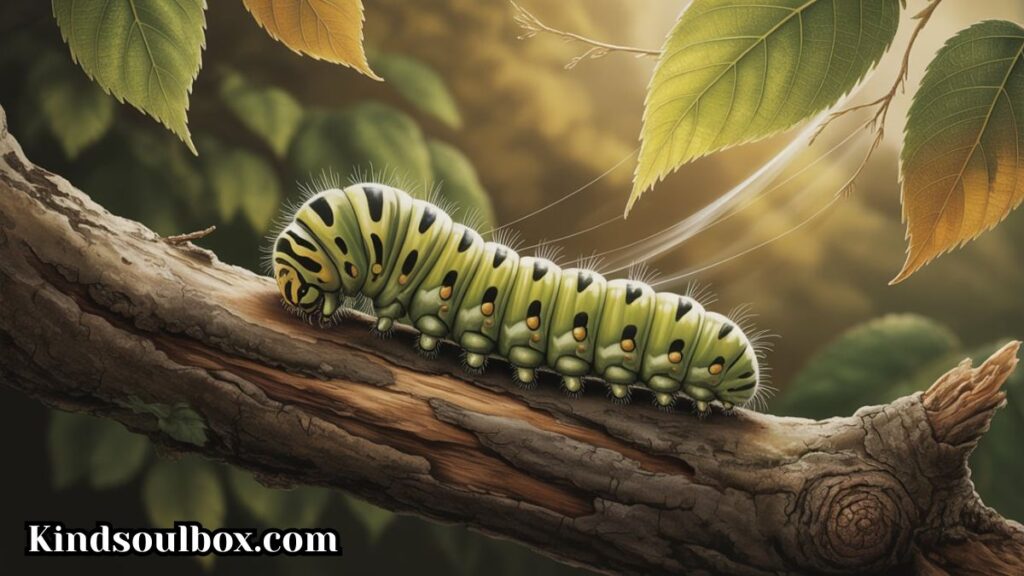
What happens inside that cocoon isn’t pretty. It’s violent. Necessary. Absolute.
The caterpillar doesn’t simply grow wings and call it a day. Scientists discovered something remarkable: the creature literally dissolves. Digestive enzymes break down most of its body into a cellular soup. Only certain specialized cells called “imaginal discs” survive to form the butterfly.
The caterpillar must die for the butterfly to live.
Galatians 2:20 captures this spiritual parallel perfectly: “I have been crucified with Christ. It is no longer I who live, but Christ who lives in me.” Paul understood that becoming a new creature in Christ requires death first.
Jesus Himself taught this principle in John 12:24: “Truly, truly, I say to you, unless a grain of wheat falls into the earth and dies, it remains alone; but if it dies, it bears much fruit.”
The Dark Chrysalis Stage
That cocoon isn’t transparent. The caterpillar enters darkness. Zero visibility. Complete vulnerability.
Christian spiritual growth often feels the same way. You surrender comfortable patterns. You release familiar identities. you let God dissolve what you’ve always been.
It’s terrifying.
Luke 9:23 doesn’t sugarcoat the requirement: “If anyone would come after me, let him deny himself and take up his cross daily and follow me.” Daily. Not once at conversion and then coast.
Dying to self means:
- Releasing control over outcomes you desperately want to manipulate
- Surrendering rights you insist you’ve earned
- Abandoning comfort zones that feel like safety
- Trusting God when circumstances scream He’s abandoned you
- Embracing obscurity in a culture obsessed with visibility
The Old Testament foreshadowed this principle dramatically. Abraham raised the knife over Isaac in Genesis 22. That father’s willingness to sacrifice his promised son—the child through whom all God’s promises would flow—demonstrated the kind of death God sometimes requires.
God provided a ram. The story ended in resurrection-like relief.
But Abraham had to walk through the valley first.
What Dying to Self Actually Looks Like
Let’s get practical because this isn’t theoretical.
A young professional felt God calling her to overseas missions. Dying to self meant releasing a six-figure career trajectory, saying goodbye to her boyfriend who wouldn’t go, and disappointing parents who’d sacrificed for her education.
The chrysalis stage lasted two years. She questioned everything. Wrestling with God felt more real than worship.
Then she emerged—not into the life she’d planned, but into the purpose she was created for. That spiritual transformation in the Bible wasn’t Instagram-worthy. It was messy, painful, and absolutely necessary.
Christ’s Resurrection: The Ultimate Emergence
The empty tomb on that first Easter morning represents the most profound metamorphosis in history.
Jesus Christ didn’t merely revive. Lazarus revived—he came back in the same mortal body and later died again. Christ’s resurrection produced something entirely different.
Matthew 28 and John 3:3 record witnesses touching Jesus’s body, watching Him eat fish, and hearing His voice. Yet this same body passed through locked doors. It appeared and disappeared. It bore crucifixion scars yet radiated glory.
The resurrection body demonstrates complete transformation, not minor renovation.
Early Christian Symbolism
By the third and fourth centuries, Christian symbolism of transformation included butterflies in catacomb art. Persecuted believers painted these creatures on tomb walls as declarations of hope of resurrection that Christianity offered.
They understood something profound. The butterfly emerging from its cocoon perfectly illustrated what resurrection symbolism in the Bible taught about believers’ future.
1 Corinthians 15:35-44 addresses the obvious question: “How are the dead raised? With what kind of body do they come?” Paul’s answer uses agricultural metaphors (seeds dying to produce plants), but the principle aligns perfectly with the butterfly symbolism of resurrection Jesus represents:
“What is sown is perishable; what is raised is imperishable. It is sown in dishonor; it is raised in glory. It is sown in weakness; it is raised in power. It is sown a natural body; it is raised a spiritual body.”
The caterpillar’s body is perishable. The butterfly’s form—while still temporary—demonstrates the principle: God makes all things new.
The Biological Miracle Matches Spiritual Truth
Consider these parallels:
| Butterfly Metamorphosis | Resurrection Truth |
|---|---|
| Complete cellular breakdown | Death and burial |
| Darkness of the chrysalis | Three days in the tomb |
| Predetermined design in DNA | God’s sovereign plan |
| Emergence in new form | Resurrection morning |
| Ability to fly (new capacity) | Glorified body capabilities |
| Same identity, different expression | Recognizable yet transformed |
Philippians 3:21 promises Christ “will transform our lowly body to be like his glorious body, by the power that enables him even to subject all things to himself.” That divine power accomplishes what’s biologically impossible.
Jesus’s resurrection wasn’t resuscitation. It was re-creation. His glorified body retained His identity—disciples recognized Him—but operated by different rules. He ate yet didn’t require food. He existed physically yet transcended physical limitations.
The butterfly gives us a tiny glimpse of this mystery.
Why the Timeline Matters
Three days in the tomb. Three stages of metamorphosis (egg, larva, pupa, adult—okay, four stages, but work with me). The number three carries significance throughout Scripture as a marker of completion and divine action.
Jonah spent three days in the fish. Jesus referenced this as foreshadowing His own death and resurrection. The parallel isn’t accidental.
Metamorphosis’s spiritual meaning intersects with biblical numerology in ways that strengthen the connection between nature and revelation. God’s creation symbolism consistently points to redemptive themes.
Baptism’s Symbolic Metamorphosis
Baptism symbolism Bible passages emphasize death, burial, and resurrection. The water serves dual purposes—it’s simultaneously tomb and womb.
Romans 6:4 states: “We were buried therefore with him by baptism into death, in order that, just as Christ was raised from the dead by the glory of the Father, we too might walk in new life.”
That phrase “walk in new life” captures everything the believer’s baptism means to communicate.
The Immersion Question
Believer’s baptism by full immersion amplifies the butterfly birth parallel in ways sprinkling cannot. When someone goes under the water completely, they enact death and burial. When they rise, soaked and gasping, they picture resurrection.
The caterpillar enters the cocoon whole. It doesn’t dip a leg in and call it good. Complete immersion. Total transformation.
Colossians 2:12 reinforces this: “having been buried with him in baptism, in which you were also raised with him through faith in the powerful working of God, who raised him from the dead.”
Historical Christian practice in the early centuries exclusively used full immersion. The linguistic roots support this—the Greek word baptizo means “to immerse” or “to plunge,” not “to sprinkle.”
Wet Wings and New Believers
Watch a butterfly emerge from its chrysalis. It’s not immediately airborne.
Those wings are crumpled, wet, useless. The creature must pump fluid through wing veins. It must dry. It must strengthen. Only then can it fly.
New life in Christ symbolism includes this often-overlooked reality: transformation takes time to manifest fully.
1 Peter 3:21 explains: “Baptism, which corresponds to this, now saves you, not as a removal of dirt from the body but as an appeal to God for a good conscience, through the resurrection of Jesus Christ.”
Baptism doesn’t save through water’s power. It saves through what it represents—union with Christ’s death and resurrection by faith.
New believers need patience. They need community. They need time to discover their capacity to “fly” spiritually. Churches that expect instant maturity miss the butterfly life cycle lesson: every stage serves a purpose.
The Believer’s Ongoing Transformation

Sanctification isn’t a one-time event. It’s a lifelong process of becoming a new creature in Christ that doesn’t conclude until we see Him face to face.
2 Corinthians 3:18 describes it beautifully: “And we all, with unveiled face, beholding the glory of the Lord, are being transformed into the same image from one degree of glory to another. For this comes from the Lord who is the Spirit.”
Notice the verb tense. “Are being transformed.” Present, continuous action.
The butterfly doesn’t emerge and immediately operate at full capacity. Those first flights are wobbly. Predators remain dangerous. Finding nectar requires learning.
The Struggle to Fly After Conversion
Christian spiritual growth involves falling, failing, and frustration. Romans 7:15-20 reveals Paul’s own struggle: “For I do not do what I want, but I do the very thing I hate.”
If the apostle Paul wrestled with transformation, why do we expect newly born-again Christians to achieve instant spiritual maturity?
Ephesians 4:22-24 outlines the practical work: “to put off your old self, which belongs to your former manner of life and is corrupt through deceitful desires, and to be renewed in the spirit of your minds, and to put on the new self, created after the likeness of God in true righteousness and holiness.”
This isn’t passive. “Put off” and “put on” are active verbs requiring intentional effort.
Temptation and the Old Garden
Butterflies sometimes return to the places they inhabited as caterpillars. Instinct draws them back to familiar territory.
Believers face the same pull. Old patterns whisper promises they can’t keep. Former relationships beckon. Previous addictions suggest just one more time won’t hurt.
Renewal of the mind, Bible verse passages like Romans 12:2 address this directly. Transformation requires changing how we think, not merely modifying behavior.
The caterpillar consumed leaves voraciously. The butterfly sips nectar delicately. Different form requires different food. Spiritual transformation means old appetites must change, not just be suppressed.
God Completes What He Starts
Philippians 1:6 provides assurance: “And I am sure of this, that he who began a good work in you will bring it to completion at the day of Jesus Christ.”
You’re not responsible for completing your own transformation. You’re responsible for cooperating with the Holy Spirit’s work. He provides the power. You provide the willingness.
Biblical lessons from butterflies include this encouragement: the chrysalis stage doesn’t last forever. Eternal life awaits on the other side of temporal struggle.
Creation Groaning: All Nature Awaits Redemption

Romans 8:19-22 reveals something startling: “For the creation waits with eager longing for the revealing of the sons of God. For the creation was subjected to futility, not willingly, but because of him who subjected it, in hope that the creation itself will be set free from its bondage to corruption and obtain the freedom of the glory of the children of God.”
Nature itself groans under sin’s curse. Every butterfly is born into a predator-filled world. Every caterpillar is vulnerable to wasps that lay eggs inside its body. every creature is subject to death.
The Curse and the Promise
When Adam sinned in the Garden of Eden, consequences rippled through all creation. Thorns appeared. Pain multiplied. Death entered.
Yet even cursed creation preaches hope.
Butterflies in the Bible meaning that extends beyond individual salvation. These creatures participate in a larger narrative about cosmic redemption.
Revelation 21:1 promises: “Then I saw a new heaven and new earth, for the first heaven and the first earth had passed away.” That’s not renovation. That’s complete re-creation.
Isaiah 11:6-9 describes the peaceable kingdom where predator and prey coexist. While poetic, it points to fundamental changes in nature‘s operations.
Will Butterflies Exist in the New Creation?
We don’t know for certain. Scripture doesn’t provide a species inventory for the new heaven and new earth.
What we know: Revelation 21:4 promises “He will wipe away every tear from their eyes, and death shall be no more, neither shall there be mourning, nor crying, nor pain anymore, for the former things have passed away.”
If butterflies exist there, they’ll face no predators. No disease. No death. Perhaps they’ll serve purely aesthetic purposes—living art displaying the Creator’s imagination.
Romans 8:18 reminds us: “For I consider that the sufferings of this present time are not worth comparing with the glory that is to be revealed to us.”
Whatever the new creation holds, it’ll surpass our wildest imaginings. Even the most spectacular monarch butterfly migration pales beside the future glory of believers.
Heaven’s Transformation: From Mortal to Immortal
1 Corinthians 15:51-52 reveals a mystery: “Behold! I tell you a mystery. We shall not all sleep, but we shall all be changed, in a moment, in the twinkling of an eye, at the last trumpet. For the trumpet will sound, and the dead will be raised imperishable, and we shall be changed.”
The speed differs from the butterfly’s slow emergence. God’s transformation happens instantaneously at Christ’s return.
But the principle remains: mortal becomes immortal. Perishable becomes imperishable. Weak becomes powerful.
What Resurrection Bodies Will Be Like
1 Corinthians 15:42-44 contrasts our current and future states:
- Sown in corruption, raised in incorruption
- Sown in dishonor, raised in glory
- Sown in weakness, raised in power
- Sown a natural body, raised a spiritual body
Jesus’s resurrection body provides our template. He could eat. Be touched. Communicate. Yet he also transcended physical limitations.
1 John 3:2 admits uncertainty while confirming certainty: “Beloved, we are God’s children now, and what we will be has not yet appeared; but we know that when he appears we shall be like him, because we shall see him as he is.”
Like Him. Not identical to Him—He remains God, we remain human. But bearing His image fully, no longer corrupted by sin.
The Butterfly Lives Longer Than the Caterpillar
Here’s an interesting biological fact: most butterflies outlive their caterpillar stage. A monarch butterfly might spend two weeks as a caterpillar but live six to eight months as a butterfly (if it’s part of the migration generation).
This parallels eternal life in heaven, Bible teaching. Our earthly existence, however long, represents the caterpillar stage. Our resurrected existence stretches into eternity without end.
Revelation 21:4 emphasizes permanence: “and death shall be no more.” No more cocoons. No more emergence. The transformation will be complete and final.
Matthew 13:43 uses striking imagery: “Then the righteous will shine like the sun in the kingdom of their Father.” Not merely reflect light—shine as light sources themselves.
Try imagining a butterfly that glows with internal radiance. Now multiply that by infinite glory. You’re beginning to grasp what hope of resurrection actually promises.
Theological Cautions: Where the Metaphor Breaks Down
Let’s be honest and careful.
Butterflies in the Bible don’t exist. This entire exploration relies on metaphorical connections, not direct scriptural teaching. That distinction matters.
The Danger of Eisegesis
Eisegesis means reading into Scripture what we want it to say rather than extracting what it actually says. The opposite—exegesis—requires disciplined interpretation that respects context, original languages, and authorial intent.
Using butterflies to illustrate biblical truths? Helpful and legitimate.
Claiming butterflies appear in Scripture? False and misleading.
Colossians 2:8 warns: “See to it that no one takes you captive by philosophy and empty deceit, according to human tradition, according to the elemental spirits of the world, and not according to Christ.”
We must never elevate nature observations to the same authority as God’s revealed Word.
Avoiding Nature Worship
Romans 1:20 states that God’s creation reveals His invisible attributes. But verse 25 warns against those who “exchanged the truth about God for a lie and worshiped and served the creature rather than the Creator.”
Butterflies point beyond themselves. They’re sermon illustrations, not objects of devotion.
Some cultures and New Age philosophies assign spiritual power to butterflies themselves—departed souls, spirit guides, karmic symbols. These interpretations contradict biblical teaching.
The biblical meaning of nature always points upward to the Creator, never inward to the creation itself.
Balance and Wisdom
We can appreciate God’s handiwork without crossing into pantheism. We can use natural metaphors without abandoning scriptural authority. we can teach children through butterfly observations while grounding lessons in actual Bible verses.
2 Timothy 3:16 reminds us: “All Scripture is breathed out by God and profitable for teaching, for reproof, for correction, and for training in righteousness.” The butterfly isn’t Scripture. It’s a teaching tool that illuminates Scripture.
That’s an important distinction in an age of spiritual confusion.
Practical Application: Living as Transformed Believers
Knowledge without application remains theoretical. What does butterfly symbolism in Christianity teach us about daily Christian living?
Embracing the Chrysalis Seasons
Suffering often precedes glory. Romans 8:18 connects them directly. When life feels dark, confined, dissolving—that’s probably a chrysalis season.
Don’t resist it. Don’t demand God explain Himself. don’t insist on shortcuts.
Trust the divine power that knows how to make caterpillars fly.
Practical steps for chrysalis seasons:
- Journal your questions without censoring doubt or anger
- Stay connected to the Christian community even when you don’t feel like it
- Maintain spiritual disciplines mechanically when you can’t maintain them emotionally
- Remember the previous transformations God has accomplished in your life
- Read Psalms that express raw emotion alongside stubborn faith
Recognizing Transformation in Others
Stop judging believers with wet wings.
That new Christian who can’t yet articulate doctrine fluently? They’re still emerging. That brother struggling with an addiction he swore would be gone after salvation? The transformation is real, even if incomplete.
Hebrews 10:24-25 instructs: “And let us consider how to stir up one another to love and good works, not neglecting to meet together, as is the habit of some, but encouraging one another.”
Encourage means “to give courage.” People mid-transformation need courage desperately.
Teaching Children Through Nature
Kids understand butterfly lessons intuitively. Raise caterpillars together. Watch the chrysalis form. Wait (impatiently) for emergence. Celebrate the first flight.
Then open Romans 6:4. Explain baptism symbolism. Connect nature to revelation in ways children can grasp.
Jesus taught using seeds, trees, birds, and sheep. Following His example means using God’s creation as an evangelism and discipleship tool.
How to Encourage Believers Mid-Transformation
Everyone knows someone stuck in the chrysalis. That friend who lost a job, faith shaken. That family member whose marriage collapsed. That coworker is questioning everything they once believed.
Offer:
- Presence without pressure for them to be “fine.”
- Prayers that acknowledge real pain while declaring real hope
- Practical help that meets immediate needs
- Patience that doesn’t demand quick fixes
- Reminders of God’s faithfulness, even when feelings lie
Philippians 1:6 becomes your anchor: God finishes what He starts. The person isn’t stuck forever. The butterfly is coming.
Conclusion
Butterflies in the Bible – a powerful symbol of hope remind us that transformation is real, not theoretical. Butterflies In The Bible. Though Scripture never names these creatures, their metamorphosis perfectly illustrates resurrection truth. Butterflies In The Bible. The caterpillar’s death in the chrysalis mirrors our dying to self. Butterflies In The Bible. The butterfly’s emergence reflects Christ’s victory over the grave and our promised glorified bodies. butterflies In The Bible.
Butterflies in the Bible – a powerful symbol of hope declare that your past doesn’t define your future in Christ. butterflies In The Bible. Every believer undergoes a radical metamorphosis through the Holy Spirit’s power. Butterflies In The Bible. The chrysalis seasons feel dark and uncertain, but they’re producing something beautiful. Butterflies In The Bible. Trust the Creator who designed nature’s transformations. He’s completing the good work He started in you, guaranteeing eternal hope through resurrection.
FAQs
Are butterflies actually mentioned in the Bible?
No, butterflies aren’t explicitly mentioned in Scripture. However, their metamorphosis powerfully illustrates biblical transformation themes found in Romans 12:2 and 2 Corinthians 5:17 about becoming a new creation in Christ.
What does a butterfly symbolize in Christianity?
Butterflies symbolize resurrection, spiritual rebirth, and transformation in Christian tradition. Butterflies In The Bible. The caterpillar’s death in the chrysalis and emergence as a butterfly mirrors Christ’s resurrection and believers’ journey from old life to new life through salvation.
Why did early Christians use butterfly imagery?
Early Christians in the 3rd-4th centuries painted butterflies in catacombs as symbols of resurrection hope. They connected the creature’s dramatic metamorphosis with Christ’s victory over death and the promise of eternal life for believers.
How does baptism relate to butterfly symbolism?
Romans 6:4 describes baptism as being buried with Christ and raised to new life—exactly what happens in metamorphosis. The water serves as both tomb and womb, just as the chrysalis represents death that leads to transformed existence.
What Bible verse best represents a butterfly transformation?
2 Corinthians 5:17 captures it perfectly: “Therefore, if anyone is in Christ, he is a new creation. The old has passed away; behold, the new has come.” This verse embodies the complete transformation butterflies demonstrate through their life cycle.