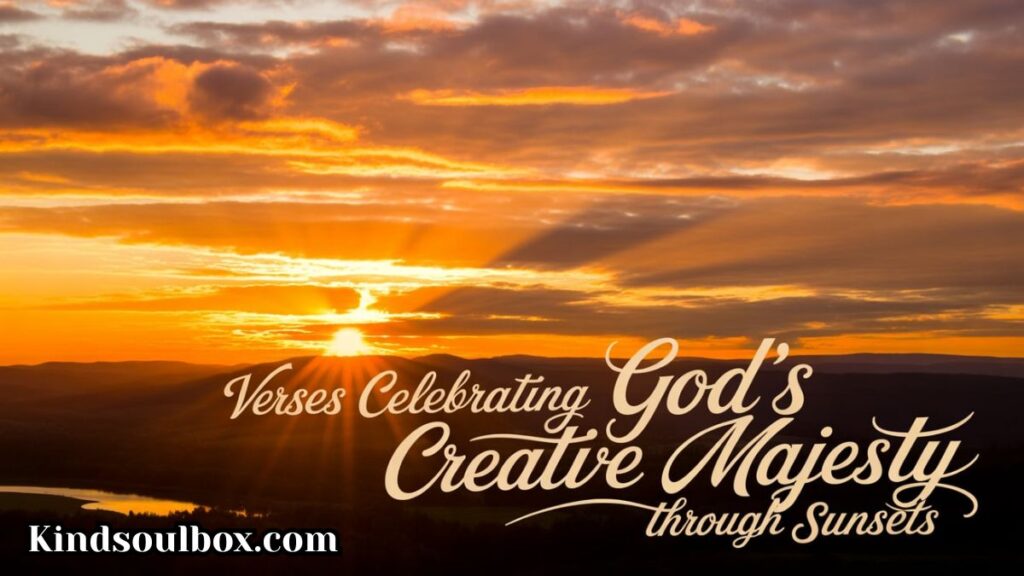
Bible verses about sunsets are scriptural passages celebrating God’s creative majesty displayed through evening skies. These verses span from Genesis to Revelation, connecting natural beauty with spiritual truths about transitions, faithfulness, and divine order woven into creation’s fabric.
Every evening, heaven ignites with impossible colors—blazing oranges melting into deep purples, golden rays piercing through clouds like celestial spotlights. These aren’t random atmospheric accidents. They’re God’s signature across the sky, painted fresh daily with the artistic nature of God that demands our attention and worship.
Scripture treats sunsets as more than pretty backdrops. They mark sacred transitions from day to night, symbolize life’s inevitable endings and beginnings, and demonstrate God’s unwavering consistency. From Psalm’s praise spanning sunrise to dusk, to Ecclesiastes’ wisdom about seasons, these verses transform ordinary sunsets into profound encounters with the Creator who orchestrates both light and darkness for His glory and our growth.
Why Sunsets Matter in Scripture: God’s Signature Across Time
The ancient Hebrews didn’t check their smartphones to know when one day ended and another began. They watched the sky. In Jewish tradition, days actually start at dusk—sunset marks the beginning, not the ending. This might seem backward to us, but it reveals something profound about biblical symbolism.
Genesis establishes this pattern immediately. “There was evening, and there was morning—the first day.” Notice the order? Evening comes first. The descent of the sun initiated each new day in God’s design, making sunsets threshold moments between what was and what’s coming.
This perspective shifts everything. Sunsets aren’t just endings. They’re doorways.
Biblical timekeeping anchored itself in observable celestial events. The rising of the sun signaled work hours. Its setting meant rest approached. This rhythm—embedded in creation itself—taught Israel to live according to divine order rather than human ambition. Ecclesiastes later captures this wisdom: there’s “a time for everything, and a season for every activity under the heavens.”
Transitions in life mirror these daily cycles. We move from one season to another, one chapter to the next. Sunsets remind us that endings and beginnings aren’t opposing forces. They’re partners in the cyclical nature of life that reflects God’s faithfulness.
Modern believers rush through days, barely noticing when artificial lights replace natural ones. But our ancestors understood what we’ve forgotten: sunsets are invitations to stillness, to contemplation of what the day held and what tomorrow might bring. They practiced evening prayer not from duty but from attunement to creation’s rhythms.
Verses Celebrating God’s Creative Majesty Through Sunsets
Genesis: The Original Sunset
Genesis 1:14-19 gives us the creation account of celestial bodies: “And God said, ‘Let there be lights in the vault of the sky to separate the day from the night, and let them serve as signs to mark sacred times, and days and years, and let them be lights in the vault of the sky to give light on the earth.’ And it was so.”
This isn’t poetic fluff. God designed the sun with intentionality. Every sunset you’ve witnessed was built into the blueprint of existence. The colors of a sunset—those impossible pinks and golds—result from atmospheric physics, but they also reveal God’s creativity. He could’ve made functional transitions between day and night that looked like nothing. Instead, He painted the sky.
Genesis 1:18 specifically mentions how these lights govern day and night, separating light and darkness. This physical reality carries spiritual weight throughout scripture. The boundary between day and night, visible at dusk, represents the boundary between good and evil, understanding and confusion, life and death.
When you watch the sun disappear below the horizon, you’re witnessing the same phenomenon that’s occurred since the fourth day of creation. That’s continuity. That’s faithfulness.
Psalm 19: The Heavens Declare
David wrote, “The heavens declare the glory of God; the skies proclaim the work of his hands. Day after day they pour forth speech; night after night they reveal knowledge” (Psalm 19:1-2).
Every sunset is a sermon. Not with words, but with color and movement. The sun’s journey from dawn to dusk tells a story about consistency, about a Creator who maintains order. Psalm 19:4-6 continues: “In the heavens God has pitched a tent for the sun. It is like a bridegroom coming out of his chamber, like a champion rejoicing to run his course.”
This poetic imagery transforms our view. The sun doesn’t just “set”—it completes a course, fulfills a purpose, finishes what it started. There’s dignity in that daily completion.
Spiritual reflection deepens when we see sunsets as communication from God. He speaks through His creation, offering verses about light and darkness that don’t need translation. The artistic nature of God displays itself most dramatically perhaps when day gives way to night.
Psalm 113: From Sunrise to Sunset
“From the rising of the sun to the place where it sets, the name of the Lord is to be praised” (Psalm 113:3).
This verse captures something essential about worship. It’s not confined to Sunday mornings or church buildings. Praise should span the full arc of the day—from dawn until dusk, from east to west, across every moment and every geography.
Sunset Bible verses like this one teach us that gratitude works best as a rhythm, not an event. When ancient Israelites recited this psalm, they acknowledged that God’s worthiness doesn’t change based on circumstances. Morning brings His mercies; evening confirms His faithfulness.
The phrase “from sunrise to sunset” also indicates completeness. Nothing falls outside this range. Nowhere on earth escapes the sun’s path. Similarly, God’s glory reaches everywhere, and our praise should match that scope.
Psalm 65: Songs at Dawn and Dusk
“Where morning dawns, where evening fades, you call forth songs of joy” (Psalm 65:8).
Notice what happens at the transitions. Dawn and dusk—those liminal spaces—are when God calls forth celebration. Not just during the bright afternoon or safe daylight hours. The margins matter.
David understood that worship flourishes at boundaries. When day births and when day dies, creation itself sings. Birds chorus at dawn. Crickets tune up at sunset. Nature models the praise we’re invited to join.
Evening Bible verses like this remind us that joy isn’t dependent on clarity or visibility. Even as light fades and darkness approaches, songs remain. That’s not denial of difficulty. That’s trust in the Father in heaven who orchestrates both day and night for our good.
Verses About Life’s Transitions and Endings
Ecclesiastes: A Time for Everything
Ecclesiastes 3:1-8 might be familiar: “There is a time for everything, and a season for every activity under the heavens: a time to be born and a time to die, a time to plant and a time to uproot…”
The passage continues through fourteen pairs of opposites. Birth and death. Planting and harvesting. Weeping and laughing. Each pair represents a transition, a movement from one state to another—much like sunset transitions day to night.
Solomon, the author, observed seasons not with frustration but with acceptance. Sunsets teach us this lesson daily. Fighting the natural end of day is futile. Raging against darkness doesn’t prevent nightfall. Instead, we learn to trust the cyclical nature of life that brings morning after every evening.
Spiritual meaning of sunsets emerges here. They’re practice runs for bigger endings. Career changes. Relationship shifts. Even mortality itself. If we can receive daily sunsets with peace, trusting tomorrow’s sunrise, we develop capacity for faith during life’s more significant transitions.
The symbolism of sunsets in scripture often points to letting go. The day is finished. Its opportunities have passed. We release control and rest, trusting God to guard the night and bring another day.
James: Life as a Mist
“Why, you do not even know what will happen tomorrow. What is your life? You are a mist that appears for a little while and then vanishes” (James 4:14).
This verse confronts the transience of life directly. We’re vapor, fog at sunrise that burns off quickly. Sobering? Yes. But also liberating.
Sunsets illustrate this brevity perfectly. That spectacular show of colors—those impossible pinks and golds—lasts maybe thirty minutes. Then it’s gone. You can’t pause it or replay it. Each sunset is unique and unrepeatable.
Your life works similarly. James isn’t being morbid; he’s being honest. Recognizing our brief span motivates us toward what matters. We don’t have unlimited sunsets ahead. This creates urgency without anxiety—an urgency to love well, serve faithfully, and walk closely with God.
The biblical symbolism connects light with life and understanding. As light fades at dusk, we’re reminded that our earthly journey has temporal boundaries. But for believers, sunset on this life means sunrise in the next.
Lamentations: Mercies New Every Morning
“Because of the Lord’s great love we are not consumed, for his compassions never fail. They are new every morning; great is your faithfulness” (Lamentations 3:22-23).
These verses appear in one of scripture’s darkest books. Jeremiah wrote Lamentations amid Jerusalem’s destruction. Yet here, in the rubble, he found hope and renewal.
The connection to sunsets is implicit. For mercies to be “new every morning,” the old ones must end. Sunset clears the slate. Night falls, covering the day’s failures and pains. Then dawn breaks with fresh compassion.
This pattern of endings and beginnings sustains us through difficulty. The worst day eventually yields to evening. Sleep brings reprieve. Morning offers another chance. God’s faithfulness operates on this daily cycle, never failing to bring light after darkness.
Evening prayer often includes confession and release. We acknowledge the day’s shortcomings, trust God’s forgiveness, and anticipate tomorrow’s grace. Sunsets make tangible this spiritual practice of letting go and looking forward.
Light, Darkness, and Divine Purpose
Matthew: Light of the World
“You are the light of the world. A town built on a hill cannot be hidden. Neither do people light a lamp and put it under a bowl. Instead they put it on its stand, and it gives light to everyone in the house. In the same way, let your light shine before others, that they may see your good deeds and glorify your Father in heaven” (Matthew 5:14-16).
Jesus spoke these words during the Sermon on the Mount. He called His followers “the light of the world”—a staggering identity. But consider the context. Light matters most when darkness approaches.
Sunsets mark that transition. As natural light fades, artificial lights become visible. Stars emerge. Campfires glow. Similarly, believers often shine brightest during cultural or personal darkness. Our faith becomes most visible during trials, not triumphs.
Letting your light shine doesn’t mean self-promotion. It means consistency. Just as sunset comes daily without fail, our witness should be steady and reliable. People watch how we handle life’s challenges, how we navigate transitions, whether our hope remains when circumstances darken.
The phrase “light of the world” also echoes God’s creative act in Genesis. He spoke light into existence. Now He calls us to reflect that light, to push back darkness through good works and love. Every sunset reminds us that darkness is temporary. Light always returns.
John: Working While It’s Day
“As long as it is day, we must do the works of him who sent me. Night is coming, when no one can work” (John 9:4).
Jesus understood urgency. He knew His earthly mission had a deadline. Sunset served as His metaphor for that approaching limit. Work happens during daylight. Dusk brings cessation.
This verse isn’t about anxiety-driven striving. It’s about intentionality. We have a finite window for kingdom work. Our days—literally and figuratively—will end. The question is what we’ll do with the light we have.
Biblical symbolism uses sunset to represent death or the end of opportunity. But there’s grace here too. We’re not responsible for working through the night. God calls us to faithfulness during our daylight hours, then releases us to rest.
Spiritual journey involves discerning what’s ours to do. Some opportunities will pass. Some doors will close. That’s not failure. It’s the natural rhythm of seasons that Ecclesiastes describes. We work faithfully while it’s our day, trust God with the outcome, and rest when evening comes.
Psalm 104: Appointed Times
“He made the moon to mark the seasons, and the sun knows when to go down. You bring darkness, it becomes night, and all the beasts of the forest prowl” (Psalm 104:19-20).
This creation psalm celebrates divine order. The sun “knows” when to set. Not by accident or randomness. By design. God appointed these times, built them into creation’s framework.
There’s comfort in ordained rhythms. Sunsets don’t happen haphazardly. You can predict tomorrow’s sunset time with precision. This reliability reflects God’s character. He’s not chaotic or capricious. He’s steady.
The verse also acknowledges that darkness has purpose. Nighttime isn’t punishment. Nocturnal creatures depend on it. Rest requires it. Light and darkness both serve in God’s economy. Neither is inherently evil; both are necessary.
Contemplation of this balance deepens our faith. We stop resisting natural cycles and instead cooperate with them. We embrace seasons—including difficult ones—as part of God’s wise orchestration rather than interruptions to be eliminated.
Worship and Reflection: Sunset Prayers in Scripture
Psalm 141: Evening Sacrifice
“May my prayer be set before you like incense; may the lifting up of my hands be like the evening sacrifice” (Psalm 141:2).
In ancient Israel, priests offered sacrifices at specific times, including evening. David connects his prayer to this ritual. His words, rising like incense smoke at dusk, become an offering to God.
Evening prayer carries special significance. It’s when we review the day, acknowledge failures, celebrate victories, and surrender control. Sunset provides a natural checkpoint for this spiritual reflection.
Creating evening Bible routines anchors us. As light fades, we light candles, open scripture, and invite God into the day’s review. This practice—older than Christianity itself—connects us to millennia of believers who did the same.
The image of upraised hands at sunset is powerful. It’s posture of surrender, acknowledgment that the day is finished and its outcome rests with God. We can’t undo what’s done. We can only offer it, trust His mercy, and prepare for tomorrow.
Genesis: Jacob’s Sunset Encounter
“When he reached a certain place, he stopped for the night because the sun had set. Taking one of the stones there, he put it under his head and lay down to sleep” (Genesis 28:11).
This verse precedes Jacob’s famous dream of angels ascending and descending a ladder. But notice what triggers this encounter: sunset. He stops traveling because darkness prevents safe passage. That pause creates space for God to meet him.
How often do sunsets force us to stop? We can’t keep driving safely. We can’t keep working productively. Darkness insists on rest. And in that rest, God often speaks.
Transitions in life frequently happen at these forced pauses. Job loss creates a stop. Illness demands rest. Retirement ends one season. Like Jacob’s sunset campsite, these unwanted pauses can become holy ground where God reveals His presence and promises.
The stone pillow isn’t about comfort. It’s about availability. Jacob made do with what was there, stayed where sunset found him, and opened himself to whatever the night might bring. That’s faith—trusting God meets us in unexpected places, even at forced stops.
Mark: Healing at Sunset
“That evening after sunset the people brought to Jesus all the sick and demon-possessed” (Mark 1:32).
Why wait until evening? Because sunset marked the Sabbath’s end. Jewish law prohibited carrying burdens or traveling far on the Sabbath. The moment the sun dipped below the horizon, restrictions lifted and people rushed to Jesus.
This scene illustrates hope. They waited all day, watching loved ones suffer. But they knew relief was coming. Sunset meant access to the Healer. Darkness brought hope, not despair.
Jesus didn’t turn anyone away. His compassion transcended time restrictions. He healed late into the night, extending His day to meet their needs. This reveals God’s heart—never too tired, never too busy, always available.
Sunset often brings exhaustion. We’re depleted by day’s demands. But these verses remind us that God’s strength doesn’t fade with the light. His power operates independently of our energy levels. Evening can be prime time for His work in our lives.
Sunset Imagery: Prophecy and Promise
Malachi: Sun of Righteousness
“But for you who revere my name, the sun of righteousness will rise with healing in its rays” (Malachi 4:2).
This prophetic verse uses solar imagery to describe the Messiah. The “sun of righteousness” brings healing, not destruction. Its rays restore rather than burn.
Biblical symbolism layers here beautifully. If there’s a coming sunrise of righteousness, that implies a preceding night. Israel endured centuries of prophetic silence—400 years between Malachi and Matthew. That’s a long sunset, a prolonged darkness.
But hope and renewal characterize God’s promises. Sunset on one era means sunrise on another. The transience of life’s difficult seasons gives way to new beginnings. What looks like an ending often precedes the greatest breakthrough.
For believers today, every earthly sunset points toward this ultimate sunrise—when Jesus returns and establishes His kingdom fully. Our current sunsets, however beautiful, are mere previews of that coming glory.
Revelation: No More Sunset
“The city does not need the sun or the moon to shine on it, for the glory of God gives it light, and the Lamb is its lamp. The nations will walk by its light… On no day will its gates ever be shut, for there will be no night there” (Revelation 21:23-25).
The final chapters of scripture reveal a reality without sunset. No darkness. No night. Perpetual light from God’s presence itself.
This eternal promise transforms how we view current sunsets. They’re temporary. The cycle of day and night belongs to this age, not the next. Every sunset we experience reminds us we’re not home yet. We’re still in the land of transitions, still in the realm where things end.
But those endings prepare us for the Endless. The constancy we sometimes find tiresome in repeated sunsets—another day done, another night approaching—teaches us to long for the Day that never ends.
Meanwhile, sunsets remain gifts. God didn’t have to make them spectacular. He could’ve designed instant switches from light to dark. Instead, He gives us these gradual, gorgeous transitions. They’re love letters from a Father who delights in His children and paints the sky to prove it.
Practical Ways to Connect Sunsets with Faith

Want to deepen your spiritual journey through sunsets? Here are concrete practices:
Sunset Sabbath Practice
- Designate Friday or Saturday evening for sunset observation
- As the sun sets, consciously release the week’s burdens
- Light candles representing God’s perpetual light
- Read evening Bible verses or a psalm
- Practice stillness for 10-15 minutes
Gratitude Journaling at Dusk
- Keep a gratitude journal specifically for sunset reflections
- Each evening, record three specific blessings from that day
- Note particular colors of the sunset or weather conditions
- Connect natural observations with spiritual parallels
- Review weekly to see patterns of God’s faithfulness
Scripture Meditation During Golden Hour Choose verses from this article and meditate on them as the sun sets:
- Genesis 1:14-19 (Creation’s design)
- Psalm 113:3 (All-day praise)
- Ecclesiastes 3:1 (Seasons and timing)
- Matthew 5:14-16 (Shining your light)
- Lamentations 3:22-23 (New mercies)
Photography as Worship
- Use your phone to capture sunset moments
- While photographing, pray about what God’s showing you
- Notice details: cloud formations, light rays, colors
- Share images with captions about God’s creativity
- Create a digital album of God’s year-long artwork
Family Sunset Rituals
- Gather family members for weekly sunset viewings
- Each person shares their day’s high and low point
- Offer prayers of thanks and seeking guidance
- Sing a hymn or worship song together
- Create consistency—same day, same practice
Walking Prayers at Dusk
- Take 20-minute walks during sunset hours
- Practice contemplation while moving
- Notice creation’s details: birds settling, temperature changes
- Pray conversationally with God about the day
- Let physical movement aid spiritual reflection
Solitude and Silence
- Find a regular spot for sunset observation
- Commit to silence for the duration of sunset
- Simply be present with God without agenda
- Let worship arise naturally from observation
- Journal afterward about insights received
Theological Reflections: What Sunsets Teach Us About God
Consistency and Faithfulness Sunsets happen every single day. No exceptions. This reliability mirrors God’s character. “Jesus Christ is the same yesterday and today and forever” (Hebrews 13:8). When life feels unpredictable, sunset’s consistency grounds us. God doesn’t change with our circumstances.
Beauty Without Utility Sunsets serve no survival function. They don’t make crops grow better or improve health. They’re pure beauty. This reveals something crucial: God creates for His glory, not just for function. He’s an Artist who delights in loveliness for its own sake. This means you—His image-bearer—have inherent worth beyond usefulness.
Generosity God gives sunsets to everyone. Rich and poor. Believers and skeptics. The same spectacular display shines on every continent, available to all who look up. This universal gift demonstrates God’s lavish generosity. He doesn’t ration beauty or restrict His creation’s wonders to the deserving. Bible Verses About Sunsets.
Humility Even the brightest day must end. The sun—despite its size and power—submits to God’s ordained rhythm. This teaches humility. Our accomplishments, however impressive, will set. Our influence will fade. Sunsets remind us that everything temporal has boundaries. Only God endures forever. Bible Verses About Sunsets.
Hope Every sunset carries an implicit promise: sunrise is coming. The darkness is temporary. Morning will break. For believers navigating grief, depression, or hardship, sunset becomes a prophetic act. It demonstrates that current darkness doesn’t get the final word. Hope and renewal are built into creation’s design.
Presence in Transition God doesn’t abandon us during endings. He’s present at thresholds, in liminal spaces, during transitions. Jacob met Him at sunset. Jesus healed at dusk. The Spirit speaks during quiet evening hours. When your life enters transition, remember: God specializes in threshold moments. Bible Verses About Sunsets.
Conclusion
Bible verses about sunsets transform how we see evening skies. They reveal God’s faithfulness painted across the horizon daily. Bible Verses About Sunsets. Each sunset becomes a sermon about endings and beginnings, hope and renewal, and divine order that never fails. Scripture invites us to find worship in these colorful transitions. Bible Verses About Sunsets.
Bible verses about sunsets offer more than poetry. They provide practical faith for daily living. Bible Verses About Sunsets. Watch tonight’s sunset with Psalm 113:3 in mind. Bible Verses About Sunsets. Let God’s brushstrokes remind you He’s constant. Every dusk declares His glory. Every evening confirms His presence. Bible Verses About Sunsets. Sunsets are love letters from your Father in heaven written in light.
FAQs
What does the Bible say about sunsets?
The Bible celebrates sunsets as markers of God’s faithfulness and creative design. Verses like Psalm 113:3 and Genesis 1:14-19 show sunsets reflect divine order and transition between day and night established at creation.
Why did biblical days start at sunset?
Jewish tradition marked days from evening to evening, following Genesis 1 pattern: “there was evening, and there was morning.” This made sunset a sacred threshold representing new beginnings rather than endings.
What is the spiritual meaning of watching sunsets?
Watching sunsets cultivates gratitude, contemplation, and awareness of God’s faithfulness. They remind us of life’s transitions, the hope of new mornings, and God’s consistent presence through all seasons of life.
Which Bible verse is best for evening prayer at sunset?
Psalm 141:2 beautifully connects evening with prayer: “May my prayer be set before you like incense; may the lifting up of my hands be like the evening sacrifice.” It frames sunset as sacred worship time.
How can I use sunsets to strengthen my faith?
Create intentional practices like sunset journaling, scripture meditation during dusk, or family gratitude rituals at evening. Pause to observe God’s daily artwork and reflect on Bible verses about sunsets while watching the sky change colors.